 by Muhammad Imran Farooqi
Contractor’s Entitlement for Termination of Contract for Convenience under Saudi Civil Transactions Law (CTL 2023) and FIDIC
I came across this post yesterday and found it insightful. I am posting it today for the benefit of my 690+followers.
…………………………………………………………………….
Termination for Convenience is one of the most significant mechanisms in international construction contracting. While the FIDIC suite of contracts (Red Book, Yellow Book, and Silver Book) grants Employers the unilateral right to terminate without Contractor default, the legal landscape in Saudi Arabia — under the Civil Transactions Law (CTL‑2023) — introduces mandatory principles that ensure fairness, good faith, and proportional compensation.
This article provides an analysis of Contractor entitlements under both frameworks:
1. Employer’s Right to Terminate under FIDIC
Under Sub‑Clause 15.5 of FIDIC (1999 and 2017 editions), the Employer may terminate the Contract at any time, for any reason, and without Contractor default. This is a no‑fault termination, meaning the Contractor is not considered in breach. The Employer must issue a formal Notice of Termination, value the Works executed up to the termination date, and pay the Contractor for all reasonable costs arising from termination.
FIDIC’s procedural framework ensures that the Employer’s commercial flexibility is balanced by the Contractor’s right to recover costs incurred in good faith.
2. Contractor’s Entitlements under FIDIC
FIDIC provides a clear cost‑based recovery mechanism for Termination for Convenience:
- Payment for Work Executed — Full valuation of Permanent and Temporary Works completed up to termination.
- Plant, Materials, and Goods — Cost of items delivered, in transit, or specially manufactured.
- Demobilization Costs — Removal of equipment, site clearance, repatriation of personnel, and closure of facilities.
- Subcontractor and Vendor Termination Costs — Cancellation fees, restocking charges, and payments for partially completed work.
- Cost of Termination — Actual expenditure plus reasonable overheads, including staff off-boarding, insurance adjustments, and documentation.
- Profit Considerations — Profit on executed work is included in BOQ rates; profit on unexecuted work is generally excluded unless allowed by Particular Conditions.
3. CTL‑2023: Mandatory Legal Principles Affecting Termination
Saudi Civil Transactions Law (CTL‑2023) introduces mandatory provisions that override any contractual clause contradicting fairness or public policy. These principles ensure that Contractors are not deprived of compensation even if the contract attempts to limit their rights.
3.1 Article 95 — Good Faith
Contracts must be performed in good faith. Termination for Convenience must not be arbitrary, disproportionate, or used to evade payment obligations. This principle supports Contractor claims for lost profit, wasted mobilization, and reliance damages.
3.2 Article 29 — Abuse of Rights
A contractual right cannot be exercised if it is intended to cause harm, if the harm is disproportionate to the benefit, or if it is used to secure an unlawful advantage. This prevents Employers from terminating after heavy Contractor mobilization and refusing compensation.
3.3 Articles 461–478 — Construction Contract Rules
These articles govern construction contracts, requiring the Employer to compensate the Contractor for all actual losses, direct and indirect damages, and necessary expenditures. They ensure the Contractor is not left with unrecovered costs.
3.4 Article 472 — Compensation for Harm
This article consolidates the compensation principle: the Contractor is entitled to recover direct, indirect, reliance, and expectation losses — including anticipated profit — arising from termination.
3.5 Article 110 — Right to Withhold Performance
If the Employer fails to meet post‑termination payment obligations, the Contractor may lawfully suspend or withhold performance until compensation is made.
Together, these articles form a unified legal foundation that supersedes any unfair contractual modification or waiver of rights.
4. Combined Effect of FIDIC and CTL‑2023
When a FIDIC contract is performed in Saudi Arabia, FIDIC governs the procedure, while CTL‑2023 governs the substance of compensation. Where FIDIC appears restrictive — such as excluding profit on unexecuted work — CTL‑2023 expands Contractor rights through mandatory principles of good faith and proportionality.
Thus, even if the Employer modifies the contract to exclude compensation, Saudi courts will not enforce such clauses. CTL‑2023 overrides them to ensure fair recovery for the Contractor.
5. Comprehensive Contractor Entitlements (FIDIC + CTL‑2023)
When a contract is terminated for convenience in Saudi Arabia, the Contractor is entitled to claim:
- Payment for all executed work (Permanent and Temporary Works)
- Cost of materials, Plant, and Goods (delivered, in transit, or specially manufactured)
- Full demobilisation and site close‑out costs
- Manpower offboarding costs (visa cancellations, end‑of‑service benefits, repatriation)
- Subcontractor and vendor termination costs
- Head office overheads (recoverable under FIDIC and CTL)
- Idle time costs for equipment and manpower until demobilisation
- Wasted mobilisation and pre‑construction costs
- Loss of anticipated profit (supported under CTL Articles 95, 29, and 472)
- Costs related to bonds, insurance, and financial instruments
- Site close‑out and handover costs (safety, environmental compliance, documentation).
6. Entitlement Matrix: FIDIC vs CTL‑2023
The compensations discussed in Section 5 of this article, for which a Contractor may reserve its right by notifying the Client, may include, but are not limited to, the following according to the provisions of CTL2023 and FIDIC books:
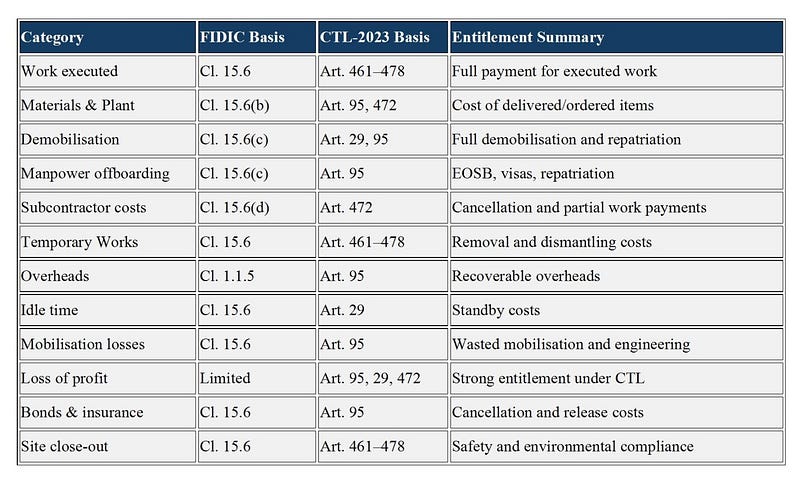
Compensations Table : CTL2023 vs FIDIC
7. Judicial Interpretation and Enforcement in Saudi Arabia
Saudi courts apply CTL‑2023 as mandatory law. Even if the Employer inserts clauses waiving compensation, such provisions are unenforceable. Courts interpret contracts through the lens of good faith and proportionality, ensuring that termination does not cause unjust enrichment or disproportionate harm.
In practice, this means:
- Unfair clauses are ignored.
- CTL‑2023 overrides restrictive contract wording.
- Contractors remain entitled to full compensation for losses and anticipated profit.
This judicial approach aligns with both Sharia principles and modern commercial fairness.
8. A way forward for Contractors
Contractors should:
- Document all mobilization and termination costs.
- Preserve correspondence and notices.
- Issue a formal reservation of rights upon receiving termination instructions.
- Prepare a detailed termination claim referencing both FIDIC and CTL‑2023.
By combining procedural compliance under FIDIC with substantive rights under CTL‑2023, Contractors can secure equitable recovery and protect their commercial interests.
Termination for Convenience under FIDIC is no longer a simple Employer option in Saudi Arabia. The CTL‑2023 framework transforms it into a balanced mechanism that safeguards Contractors against disproportionate harm while maintaining the Employer’s flexibility. Contractors who understand this interplay are better positioned to negotiate fair settlements and avoid prolonged disputes.