Lessons From Sidra Hospital. THe OHLA JV Project Disaster in Doha Qatar. (2014 to 2025)

FOREWORD
Large construction disputes are often remembered by their headline numbers: the contract sum, the claim quantum, the final award. That focus is understandable, but it is also misleading.
Most arbitrations are not decided by scale. They are decided by structure.
The Sidra Hospital arbitration is a clear illustration of this truth. Despite its extraordinary size and complexity, the dispute ultimately turned not on ambition, effort, or even technical difficulty, but on the way risk migrated, evidence accumulated, and legal positions hardened long before the matter reached a tribunal.
This book does not seek to retell the Sidra dispute as a drama of failure or fault. Nor does it attempt to reconstruct the internal decision-making of the parties involved. Instead, it examines Sidra as a system — a sequence of predictable legal and evidential transitions that many large projects undergo without recognising their consequences.
The value of the case lies precisely in its ordinariness. Strip away the scale, and Sidra reflects patterns seen repeatedly in healthcare facilities, data centres, transport infrastructure, and other performance-critical projects delivered under fixed-price, outcome-based contracts.
This book is written for contractors, consultants, and project leaders who want to understand not merely what went wrong, but when the project became unrecoverable, even though construction continued.
That moment is rarely obvious on site. It is almost always obvious in arbitration.
CASE OVERVIEW
The Sidra Hospital dispute arose from one of the Middle East’s most ambitious healthcare infrastructure projects, commissioned by Qatar Foundation and delivered under a fixed-price design-and-build contract.
Awarded in 2009 to a joint venture led by Obrascon Huarte Lain S.A. (OHLA) and Contrack Cyprus Limited, the project carried a reported contract value of approximately £1.9 billion, placing it among the most significant hospital construction undertakings globally at the time.
The project’s scale, complexity, and visibility were exceptional. Sidra was conceived as a world-class specialist hospital and research facility, incorporating advanced medical systems, performance-critical environments, and highly demanding commissioning requirements. These characteristics placed extraordinary pressure on design coordination, interface management, and systems integration.
In 2014, Qatar Foundation terminated the contract, alleging extensive delay, defects, and breach. Performance and advance payment guarantees were called. The termination triggered arbitration proceedings under the ICC Rules, governed by Qatari law.
The employer advanced claims reported to exceed €950 million, encompassing alleged termination damages, delay-related losses, and remedial costs. The joint venture rejected the termination as unlawful and pursued substantial counterclaims relating to unpaid work, variations, extensions of time, and the recovery of guarantees.
The arbitration spanned several years and involved multiple partial awards addressing discrete issues of liability and entitlement.
In July 2025, the ICC tribunal issued its principal award. While the employer’s claims were largely rejected, the tribunal initially found the joint venture liable for a net amount of approximately QAR 104.6 million — a fraction of the sums originally asserted.
In December 2025, the tribunal issued a correction addendum addressing a computational error. The corrected net liability was reduced to approximately QAR 3.8 million.
This adjustment materially altered the financial consequences of the dispute and significantly reduced the joint venture’s ultimate exposure. It also underscored an often-overlooked feature of arbitration: even final awards may be shaped by narrow issues of proof, arithmetic, and procedural precision.
WHY THIS CASE IS EXAMINED
Sidra is not examined in this book because of its final monetary outcome. Measured purely by the net award, the case could be dismissed as unremarkable.
That would be a serious mistake.
Sidra is examined because it demonstrates how extremely large claims are narrowed, filtered, and often dismantled through tribunal scrutiny. It shows how termination disputes frequently dictate quantum outcomes more decisively than headline allegations of delay or defect. And it reveals arbitration as a process of progressive reduction and refinement, rather than affirmation of initial positions.
Unlike disputes that turn on enforcement strategy or jurisdictional manoeuvring, Sidra illustrates a more fundamental lesson: large claims often fail not at the enforcement stage, but at the tribunal stage, through the collapse of entitlement, causation, and evidential discipline.
In that sense, Sidra is not exceptional. It is representative.
TABLE OF CONTENTS
Foreword
Case Overview
Why This Case Is Examined
Introduction — The Sidra Operating Model
Part I — The Project and Its Failure
Chapter 1 — Design Responsibility: When “Fit for Purpose” Becomes a Trap
Part II — Delay, Disruption, and Recovery
Chapter 2 — Scope Drift: When Change Stops Being a Variation
Chapter 3 — Delay: Why Most Delay Claims Die Quietly
Chapter 4 — Disruption & Productivity: Why “We Worked Harder” Never Works
Chapter 5 — Recovery & Acceleration: When Mitigation Destroys Entitlement
Part III — Termination and Dispute Escalation
Chapter 6 — Termination: When Failure Is Legally Manufactured
Part IV — Arbitration and Tribunal Scrutiny
Chapter 7 — The Contractor’s Playbook: Lessons Learned from Sidra
Part V — Award, Correction, and Finality
Part VI — Why OHLA JV lost the Case
Part VII — Lessons for Contractors
Closing Reflection — A Different Path Exists
Appendices
Appendix A — Arbitration Facts and Case Details
Appendix B — Key Events Timeline
Appendix C — Fact Checklist (At a Glance)
Sources and Research Basis
This publication is based exclusively on publicly available materials.
These include published court judgments and rulings arising from arbitration-related proceedings, publicly available regulatory filings, financial disclosures, and market announcements, reputable industry and legal reporting concerning major international construction disputes, and established principles and practices recognised in international construction arbitration.
No confidential arbitration records, pleadings, witness statements, expert reports, or internal project documents have been accessed or relied upon in the preparation of this work.
Where factual background is described, it is drawn from information expressly recorded in public judicial decisions or other publicly accessible sources. No attempt has been made to supplement or infer facts beyond what is publicly available.
Methodology and Analytical Approach
This book does not attempt to reconstruct the internal decision-making, conduct, motivations, or professional competence of any party involved in the projects discussed.
The methodology adopted is deliberately outcome-focused and tribunal-centred.
The analysis proceeds by identifying procedural and evidential features recorded in public judgments, examining how tribunals and courts have treated specific categories of claims, defences, and evidence, extracting generalised risk patterns arising in complex international construction projects, and presenting these observations as practical lessons for contractors, consultants, and project stakeholders operating in similar contractual environments.
All “lessons learned” are framed as general risk observations. They are not findings of fault, negligence, misconduct, or professional failure by any party.
Educational Purpose and Scope
This publication is intended solely for educational, analytical, and professional development purposes.
It does not constitute legal advice, does not purport to determine liability, and does not express conclusions on the merits of any arbitration or dispute beyond what is recorded in public judicial materials.
Any opinions expressed are analytical observations on tribunal behaviour, evidential thresholds, and risk allocation practices. They are offered to assist industry participants in understanding how disputes are assessed in arbitration, not to advocate particular outcomes.
Disclaimer
Nothing in this publication should be construed as:
- an allegation of wrongdoing, incompetence, or bad faith by any individual or organisation;
- a definitive account of matters not expressly stated in public judgments; or
- a commentary on the private conduct of parties beyond what is publicly recorded.
References to specific projects or disputes are used solely as illustrative case studies to highlight broader contractual, evidential, and arbitration risks encountered in international construction projects.
PART I — THE PROJECT AND ITS FAILURE
CHAPTER 1
DESIGN RESPONSIBILITY
How a Contractor Quietly Inherits All the Risk
1.1 How Design Responsibility Looks Harmless at the Start
At the beginning of most large projects, design responsibility rarely feels dangerous.
The employer appoints a contractor under a design-and-build contract. Consultants are involved. Submissions are reviewed. Workshops are held. Drawings are commented on. Changes are discussed openly.
On site, it feels collaborative.
Most contractors therefore believe that design responsibility is shared, or at least managed jointly.
This belief is wrong — not because it is unreasonable, but because it does not reflect how tribunals later interpret contracts.
In arbitration, design responsibility is not about who contributed ideas.
It is about who promised the final result.
Once a contractor agrees to deliver a working hospital, operational data centre, or fully commissioned facility, the law treats everything leading to that outcome as the contractor’s responsibility unless the contract clearly says otherwise.
Sidra Hospital is a textbook example of how this responsibility quietly migrates.
1.2 The Difference Between “Designing” and “Guaranteeing”
Most engineers and project managers think of design as a professional activity.
They think in terms of:
- reasonable skill and care
- peer review
- consultant approvals
- compliance with drawings and specifications
Tribunals do not think this way.
Tribunals ask a much simpler question:
Did the contractor guarantee that the completed facility would work?
If the answer is yes, then:
- design becomes a means, not a defence
- approval becomes procedural, not protective
- difficulty becomes irrelevant
At Sidra, the contract required the contractor to deliver a fully functioning hospital capable of passing commissioning and operational testing.
Once that promise was made, the tribunal did not care:
- how many consultants were involved
- how many meetings were held
- how many drawings were approved
The only thing that mattered was whether the outcome was achieved.
1.3 How Performance Standards Transfer Risk Without Anyone Noticing
One of the most dangerous features of modern construction contracts is the use of performance standards.
These are phrases such as:
- “world-class healthcare facility”
- “international best practice”
- “suitable for continuous clinical operation”
- references to external guidelines and codes
On paper, these phrases look harmless. They sound aspirational. They appear flexible.
Legally, they are open-ended obligations.
At Sidra, performance was defined not just by drawings, but by:
- system integration
- operational readiness
- successful testing and commissioning
Crucially, many of these standards were not frozen to a specific edition, year, or measurable threshold.
What happened next is extremely common.
As the project progressed:
- standards were refined
- expectations were raised
- interpretations became stricter
- “minimum compliance” slowly turned into “full optimisation”
Because no clear boundaries were set at the start, the contractor inherited responsibility for meeting whatever standard was applied at the end.
The tribunal later treated this as assumed risk, not unfair expansion.
1.4 Why Design Approval Does NOT Protect the Contractor
On live projects, design approvals feel reassuring.
Drawings are stamped. Comments are closed. Consultants sign off. Workshops conclude with agreement.
Most contractors believe this means:
“If it was approved, it can’t be our fault.”
Tribunals do not agree.
Unless the contract explicitly says that approval transfers risk, tribunals treat approval as:
- confirmation that a process was followed
- not confirmation that responsibility has shifted
At Sidra:
- designs were reviewed
- comments were resolved
- approvals were issued
Yet when systems failed to perform as required, the tribunal held that:
- approval did not dilute responsibility
- approval did not change the outcome obligation
- approval did not excuse performance failure
This shocks many contractors when they first encounter it in arbitration.
But it is entirely consistent with how design-and-build contracts operate.
1.5 The Three Things That Should Have Been Locked (But Were Not)
Sidra did not fail because the contractor was careless.
It failed because three protective mechanisms were not locked early.
(1) Fixed Acceptance Criteria
Performance obligations must be measurable.
If success cannot be measured, risk cannot be controlled.
Sidra relied on broad functional descriptions rather than hard pass/fail thresholds.
(2) Assumptions Registers
Every major design assumption should be recorded and agreed.
At Sidra, many assumptions were implicit:
- about usage
- about operational modes
- about interface readiness
When those assumptions changed, the risk stayed with the contractor.
(3) Design Responsibility Matrix
Who defines?
Who reviews?
Who warrants?
These roles must be separated explicitly.
At Sidra, collaboration blurred these lines. Legally, the blur favoured the employer.
1.6 How the Tribunal Looked at the Design Dispute
When the dispute reached arbitration, the tribunal did not re-run the design process.
It did not ask:
- whether the contractor acted reasonably
- whether the employer contributed to confusion
- whether the project was unusually complex
Instead, it asked:
- What did the contract promise?
- Was that promise fulfilled?
- Was risk clearly shifted away from the contractor?
Because the answers favoured the employer, the design case ended there.
The contractor’s explanations were detailed. They were also legally irrelevant.
1.7 The Real Lesson of Design Responsibility
The real danger of design responsibility is not technical failure.
It is legal silence.
When contractors:
- accept evolving standards
- rely on approvals
- fail to lock assumptions
- treat collaboration as shared risk
They do not notice that responsibility has already shifted.
By the time performance is tested, the legal position is fixed.
Sidra demonstrates this clearly.
Design responsibility was not argued away.
It was inherited quietly.
CHAPTER 2
SCOPE DRIFT
How “Just Do It First” Destroys Entitlement
2.1 How Scope Drift Starts (and Why Nobody Panics)
Scope drift almost never starts with a formal instruction.
It starts with a conversation.
A coordination meeting.
A consultant’s comment.
A request to “just adjust this slightly.”
A suggestion that something “should be aligned to the latest requirement.”
On site, none of this feels dangerous.
Everyone understands that large projects evolve. Drawings are refined. Interfaces are coordinated. Standards are clarified. This feels like normal project life.
At Sidra, scope drift began exactly this way.
No one announced that the contract scope was changing. There was no dramatic instruction. Instead, work gradually expanded through hundreds of small steps that felt reasonable at the time.
The danger is that tribunals do not look at how scope feels.
They look at how it was treated when it happened.
2.2 The Difference Between a Variation and an Interpretation
This distinction decides whether money is payable.
A variation is a change to what the contractor agreed to do.
An interpretation is a clarification of what the contractor already agreed to do.
Tribunals treat these two very differently.
If work is treated as a variation:
- it is priced
- time is considered
- entitlement is preserved
If work is treated as interpretation:
- it is assumed to be included
- cost is absorbed
- entitlement disappears
At Sidra, much of the expanded work was implemented as “interpretation”.
That single choice — often made under delivery pressure — destroyed recoverability later.
2.3 The Language That Quietly Kills Claims
Certain words are deadly in arbitration.
Not because they are wrong, but because tribunals interpret them harshly.
Words like:
- “clarify”
- “align”
- “rationalise”
- “coordinate”
- “comply with updated requirement”
On site, these words sound harmless.
In arbitration, they are treated as acceptance.
At Sidra, additional work was carried out under exactly this language. Emails recorded cooperation. Minutes recorded agreement. Work proceeded.
Years later, when claims were submitted, the tribunal did not ask whether the work was more extensive.
It asked:
“Why was this treated as clarification when it was done?”
There was no convincing answer.
2.4 Why “We Had No Choice” Does Not Work
Contractors often argue that they had no choice.
They say:
- the work had to be done
- the project would fail otherwise
- refusal was not realistic
Tribunals understand commercial pressure.
They do not treat it as legal compulsion.
If work is implemented without reservation, tribunals assume:
- the contractor accepted it as included
- the contractor priced the risk
- the contractor chose to proceed
At Sidra, cooperation was interpreted as consent.
The tribunal did not criticise the contractor for helping the project.
It simply treated the help as non-compensable.
2.5 The Administrative Trap: Doing First, Claiming Later
One of the most common mistakes in large projects is the belief that entitlement can be sorted out later.
Teams say:
- “Let’s do the work first.”
- “We’ll deal with valuation after.”
- “We’ll sort it out at final account.”
This approach almost never succeeds in arbitration.
Tribunals fix entitlement at the time the work is done, not when claims are written.
At Sidra, by the time formal claims were prepared:
- the work had long been completed
- the language used showed acceptance
- reservations were weak or missing
The tribunal treated entitlement as already decided.
2.6 Why Cumulative Change Is Hard to Prove
Contractors often rely on cumulative impact arguments.
They say:
- “Each change was small, but together they were massive.”
- “The overall scope increased dramatically.”
Tribunals are sceptical of this approach.
They do not measure cumulative impact emotionally.
They measure it administratively.
They ask:
- Were individual changes identified?
- Were they reserved?
- Were they priced?
- Was impact recorded contemporaneously?
At Sidra, cumulative change was real.
But because it was not administratively captured, it became legally invisible.
2.7 Retrospective Re-Labelling Always Fails
Another fatal mistake is trying to re-label work after the fact.
Work done as:
- clarification
- coordination
- compliance
is later claimed as:
- variation
- additional scope
- change
Tribunals almost always reject this.
They fix the character of work at execution, not at pleading.
Sidra attempted to recover absorbed scope retrospectively. The tribunal refused. The language used at the time was decisive.
2.8 What Proper Scope Protection Looks Like (In Real Life)
Protecting scope does not mean being obstructive.
It means being disciplined.
In practice, this requires:
- treating every clarification as a potential variation
- reserving rights before implementation
- issuing provisional valuation notices
- tracking cumulative impact contemporaneously
None of this stops work.
It simply preserves entitlement.
Sidra did not lack cooperation.
It lacked administrative resistance.
2.9 How the Tribunal Viewed Scope at Sidra
The tribunal’s reasoning was straightforward.
It found:
- implementation without reservation
- acceptance of revised requirements
- absence of contemporaneous valuation
On that basis, it concluded that the expanded work formed part of the original bargain.
No matter how extensive the scope felt, legally it was already absorbed.
2.10 The Real Lesson of Scope Drift
Scope drift is dangerous because it feels helpful.
Contractors solve problems. They keep projects moving. They absorb short-term pain to avoid long-term disruption.
In arbitration, that behaviour is punished, not rewarded.
Sidra demonstrates that scope drift does not destroy projects immediately.
It destroys claims quietly.
By the time arbitration begins, entitlement is already gone.
CHAPTER 3
DELAY
Why Everyone Can See the Delay — but Nobody Gets Paid for It
3.1 Why Delay Feels Obvious on Site
On site, delay is one of the easiest things to recognise.
Activities don’t start on time.
Milestones slip.
Programmes are revised again and again.
Completion dates quietly move.
Everyone feels it. Everyone talks about it.
At Sidra, delay was not subtle. The project ran behind schedule. Recovery measures were implemented. Pressure mounted. Time became the dominant issue.
So when the dispute reached arbitration, the contractor believed delay was self-evident.
This belief is one of the most common — and most damaging — misunderstandings in construction disputes.
3.2 Why Tribunals See Delay Very Differently
Tribunals do not ask:
“Was the project delayed?”
They ask:
“Can you prove, step by step, that the employer caused delay to contractual completion?”
This difference is critical.
In arbitration, delay is not a feeling or a condition.
It is a legal argument that must be constructed precisely.
Sidra demonstrates this gap perfectly:
- delay existed in reality
- delay failed legally
3.3 The Three Questions Every Tribunal Asks About Delay
Tribunals analyse delay by asking three simple but unforgiving questions.
Question 1: What exactly caused the delay?
Not “lots of issues”.
Not “overall disruption”.
A specific event must be identified:
- late drawings
- late access
- late approvals
- instructed changes
At Sidra, many such events existed — but they overlapped heavily.
Question 2: Who was responsible for that event?
This is where many claims collapse.
If responsibility is shared, unclear, or mixed with contractor inefficiency, entitlement weakens sharply.
At Sidra, employer-caused delay existed, but so did:
- resequencing
- design development
- recovery measures
- coordination problems
Tribunals do not like mixed causes.
Question 3: Did that event delay the final completion date?
This is the hardest part.
Delaying a local activity is not enough.
Delaying a milestone is not enough.
The delay must be shown to affect the contractual completion date.
At Sidra, this link was repeatedly broken.
3.4 The Baseline Programme Problem (Explained Simply)
To prove delay, you need a reference point.
That reference point is the baseline programme — the agreed plan showing how the project was supposed to finish.
If the baseline keeps changing, tribunals ask:
“Delayed compared to what?”
At Sidra:
- programmes were revised frequently
- logic was adjusted to reflect reality
- recovery activities were layered in
From a management perspective, this was sensible.
From a legal perspective, it was disastrous.
Each revision weakened the ability to prove cause and effect.
3.5 Why Constant Programme Updates Hurt Delay Claims
Contractors often believe updated programmes help their case.
They don’t.
Tribunals become suspicious when:
- critical paths keep moving
- activities are resequenced repeatedly
- completion is achieved through workarounds
They conclude that:
- delay was managed internally
- no single event can be isolated
- causation is unclear
This is exactly what happened at Sidra.
The programme told a story of effort and adaptation — not a story of employer-caused delay.
3.6 Concurrency Explained in Plain Language
Concurrency is one of the most misunderstood concepts in construction law.
Simply put:
If the contractor and the employer are both causing delay at the same time, tribunals often award nothing.
This feels unfair to many contractors.
But tribunals reason as follows:
- If two causes overlap
- and one of them is the contractor’s responsibility
- then the contractor has not proven exclusive entitlement
At Sidra, delays overlapped:
- employer changes
- contractor resequencing
- recovery acceleration
The tribunal did not try to untangle them generously.
It simply refused entitlement.
3.7 Why “Global Delay” Arguments Fail
When delay becomes widespread, contractors often explain it globally:
- “Everything affected everything.”
- “The project environment collapsed.”
This may be true in reality.
Tribunals dislike it.
They prefer:
- narrow windows
- single causes
- clean links to completion
Sidra’s delay narrative was broad.
The tribunal required precision.
Precision was missing.
3.8 Recovery Measures That Quietly Kill Delay Claims
One of the most painful lessons from Sidra is this:
The harder the contractor tried to recover time, the harder it became to prove delay.
Why?
Because:
- acceleration absorbs delay
- resequencing avoids critical path impact
- parallel working masks causation
Tribunals interpret this as:
“If you could recover it, maybe it wasn’t an employer delay.”
At Sidra, recovery preserved progress but destroyed proof.
3.9 Why “Everyone Knew We Were Delayed” Does Not Matter
Contractors often say:
- “The employer knew.”
- “Everyone agreed we were delayed.”
Tribunals do not rely on shared understanding.
They rely on:
- records
- programmes
- notices
- causation analysis
At Sidra, knowledge of delay did not equal proof of entitlement.
3.10 How the Tribunal Decided the Delay Issue
The tribunal did not deny that the project suffered delay.
It denied that delay could be proven to the legal standard required.
Overlapping causes, unstable baselines, and recovery actions defeated causation.
This distinction matters enormously.
Delay existed.
Entitlement did not.
3.11 The Real Lesson About Delay
Delay claims do not fail because contractors are wrong.
They fail because delay is treated as a project fact instead of a legal argument.
Sidra shows that by the time arbitration begins, delay entitlement has usually already been lost.
Not through bad faith — but through everyday delivery decisions.
CHAPTER 4
DISRUPTION & PRODUCTIVITY
Why “We Worked Harder” Never Gets Paid
4.1 What Disruption Actually Means on a Real Project
Disruption is not the same as delay.
Delay means finishing late.
Disruption means finishing with more effort than planned.
On site, disruption looks like this:
- crews waiting for information
- work being stopped and restarted
- trades working out of sequence
- congestion in work areas
- rework after late changes
- constant firefighting
At Sidra, this was everyday reality.
People worked longer hours. More manpower was added. Tasks took longer than planned even when deadlines were met.
From a contractor’s point of view, this feels like obvious loss.
From a tribunal’s point of view, it is only a problem if it can be measured properly.
4.2 Why Tribunals Are Suspicious of Disruption Claims
Tribunals are cautious about disruption claims for a simple reason:
Almost every troubled project feels disrupted.
If tribunals accepted disruption claims based on difficulty alone, almost every contractor would be compensated on almost every project.
So tribunals demand hard proof.
They assume:
- some inefficiency is normal
- some chaos is self-inflicted
- some problems are management issues
Sidra shows this clearly. The tribunal did not doubt that the project was difficult. It doubted whether the disruption could be isolated, measured, and blamed on the employer alone.
4.3 The Key Question Tribunals Ask About Productivity
Tribunals always ask one basic question:
“Compared to what?”
To prove disruption, a contractor must show:
- how fast the work should have been done, and
- how much slower it actually was, and
- why the employer caused the difference
Without a clear comparison, there is no claim.
At Sidra, this comparison was missing.
4.4 The “Measured Mile” Explained in Plain Language
The most accepted way to prove disruption is called the measured mile.
In simple terms, it means:
- find a period where work went smoothly
- measure productivity during that period
- compare it to productivity during the disrupted period
- claim the difference
This sounds straightforward.
In practice, it is very hard.
At Sidra:
- the project was complex from the start
- disruption existed early
- work areas overlapped
- systems were interdependent
There was no “clean” period that could be used as a benchmark.
Without a clean baseline, the measured mile collapses.
4.5 Why Complexity Makes Disruption Claims Harder — Not Easier
Contractors often argue:
“This project was too complex to measure productivity precisely.”
Tribunals respond silently:
“Then you should have measured it even more carefully.”
Complexity does not lower the proof threshold.
It raises it.
On a hospital project like Sidra:
- specialist systems interact
- access is restricted
- commissioning requirements are strict
Tribunals therefore expect:
- detailed records
- labour tracking by location
- clear links between events and inefficiency
Sidra did not meet this standard.
4.6 The Contamination Problem (Why Productivity Gets Blamed on the Contractor)
Disruption claims often fail because of contamination.
Contamination happens when:
- employer-caused problems
- and contractor decisions
- and recovery measures
all happen at the same time.
When this happens, tribunals struggle to separate cause and effect.
At Sidra:
- acceleration was ongoing
- resequencing was constant
- additional manpower was added
- work methods changed repeatedly
The tribunal could not confidently say:
“This inefficiency was caused only by the employer.”
When in doubt, tribunals usually say no.
4.7 Why “We Worked Longer Hours” Does Not Prove Loss
Many contractors rely on effort-based arguments.
They say:
- overtime increased
- supervision increased
- teams were stretched
- pressure was extreme
Tribunals do not pay for effort.
They pay for measured loss.
Working harder does not automatically mean working less efficiently in a legally provable way.
At Sidra, effort was real.
Proof was not.
4.8 Why Retrospective Productivity Models Are Distrusted
Disruption claims are often built after the project ends.
Experts reconstruct productivity using:
- averages
- assumptions
- models
Tribunals treat these models cautiously.
They prefer:
- contemporaneous records
- real data
- site-level evidence
Sidra relied heavily on retrospective analysis. The tribunal found it insufficient.
4.9 How Disruption Claims Quietly Die
Disruption claims rarely fail loudly.
They are not rejected because they are unbelievable.
They fail because:
- baselines are missing
- contamination exists
- attribution is unclear
- records are weak
This is exactly what happened at Sidra.
The tribunal did not say:
“There was no disruption.”
It said:
“We cannot measure it reliably.”
That difference is everything.
4.10 What Proper Disruption Protection Looks Like in Practice
To protect disruption claims, contractors must:
- identify clean work areas early
- track productivity by crew and location
- link inefficiency to specific events
- separate recovery work from original scope
This requires discipline during delivery, not after.
Sidra tried to explain disruption later. Tribunals do not accept that.
4.11 The Real Lesson of Disruption
Disruption is one of the most expensive problems on complex projects.
It is also one of the hardest to recover.
Sidra shows that unless disruption is measured while it is happening, it will almost always be lost in arbitration.
Hard work is not enough.
Difficulty is not enough.
Good intentions are not enough.
Only proof survives.
CHAPTER 5
RECOVERY & ACCELERATION
How Trying to Save the Project Can Destroy Your Claims
5.1 Why Contractors Instinctively Try to Recover
When a project starts falling behind, most experienced contractors react immediately.
They:
- add manpower
- extend working hours
- resequence work
- overlap activities
- push suppliers harder
- find temporary workarounds
From a project management perspective, this is the right instinct.
Nobody wants to be blamed for failure. Nobody wants termination. Nobody wants reputational damage.
At Sidra, recovery became the dominant focus once delay became apparent. Resources increased. Work was rearranged. Pressure intensified.
The project kept moving.
Legally, however, something dangerous was happening.
5.2 Why the Law Sees Recovery Very Differently
The law treats recovery differently from project teams.
On site, recovery is seen as:
“We had no choice.”
In arbitration, recovery is often seen as:
“You chose to deal with it.”
This difference matters.
Tribunals assume that if a contractor:
- accelerates without instruction
- absorbs inefficiency
- changes methods voluntarily
then the contractor has accepted responsibility for managing the problem.
Sidra shows how this assumption operates in practice.
5.3 The Difference Between Instructed Acceleration and Silent Acceleration
Acceleration only preserves entitlement if it is:
- instructed by the employer, or
- clearly directed with cost and time consequences acknowledged
This is called instructed acceleration.
What happens far more often is silent acceleration:
- the contractor accelerates without instruction
- does not reserve rights clearly
- hopes to claim later
Tribunals dislike silent acceleration.
At Sidra, much of the acceleration fell into this category. Work was pushed harder, but without a clear instruction tying it to employer-caused delay.
The tribunal treated this as a contractor decision.
5.4 Why “We Had No Choice” Fails Legally
Contractors often argue:
- refusing to accelerate would have led to termination
- commercial pressure left no alternative
- cooperation was necessary
Tribunals understand commercial pressure.
They do not treat it as legal compulsion.
Unless the contract removes choice explicitly, tribunals assume the contractor still had options:
- reserve rights
- seek instruction
- price acceleration
- refuse without confirmation
At Sidra, these options were rarely exercised consistently.
As a result, recovery was treated as voluntary.
5.5 How Recovery Destroys Delay Claims
This is one of the hardest lessons for contractors to accept.
Recovery often:
- removes critical path impact
- absorbs delay into effort
- masks the effect of employer-caused events
Tribunals then ask:
“If you recovered the time, where is the delay?”
At Sidra:
- recovery measures avoided visible slippage
- completion dates were defended
- programmes were reworked
Legally, this made it harder to prove that the employer caused delay to completion.
The harder the contractor worked to recover, the weaker the delay claim became.
5.6 How Recovery Also Destroys Disruption Claims
Recovery does not just affect delay.
It contaminates productivity evidence.
When:
- crews are changed
- working hours are extended
- tasks are resequenced
it becomes impossible to say:
“This inefficiency was caused by the employer, not by our recovery choices.”
At Sidra, recovery and disruption happened together. The tribunal could not separate them.
When separation is impossible, entitlement is usually denied.
5.7 The Cost Absorption Trap
Recovery costs are often absorbed quietly.
Overtime is booked as preliminaries.
Extra supervision is treated as overhead.
Additional plant is spread across budgets.
From an accounting perspective, this keeps the project moving.
From a legal perspective, it is fatal.
Tribunals compensate identified loss, not hidden expenditure.
At Sidra, recovery costs were real and significant. But because they were not clearly segregated and attributed, they were treated as assumed.
5.8 Why Late Claims for Recovery Rarely Succeed
Contractors often believe:
“Once the dust settles, we’ll sort out the costs.”
Tribunals fix entitlement when the decision is made, not when the claim is written.
If recovery is implemented without:
- reservation
- attribution
- contemporaneous valuation
it is almost impossible to recover later.
Sidra attempted to recover acceleration costs retrospectively. The tribunal refused.
5.9 What Proper Recovery Discipline Looks Like
Proper recovery does not mean doing nothing.
It means:
- identifying the cause of delay before acting
- reserving rights clearly
- linking recovery actions to employer-caused events
- tracking costs separately
- seeking instruction where possible
This requires courage and discipline under pressure.
Sidra prioritised progress. Legal discipline suffered.
5.10 How the Tribunal Viewed Recovery at Sidra
The tribunal did not criticise the contractor for trying to save the project.
It simply concluded that:
- recovery was largely voluntary
- attribution was unclear
- costs were absorbed
On that basis, recovery-related claims failed.
5.11 The Real Lesson of Recovery
Recovery feels heroic.
In arbitration, it often looks like concession.
Sidra shows that trying to save the project without protecting entitlement can destroy claims silently.
By the time arbitration begins, the damage is already done.
PART III — TERMINATION AND DISPUTE ESCALATION
CHAPTER 6
TERMINATION
How a Project Becomes Impossible to Save (Legally)
6.1 Why Termination Is Rarely a Sudden Shock
Most people remember termination as a dramatic moment.
A letter is issued.
Security arrives.
The contractor is removed from site.
Guarantees are called.
From the contractor’s point of view, termination feels sudden and extreme.
From a tribunal’s point of view, termination is almost never sudden.
Tribunals treat termination as the final step in a long paper trail. They do not focus on the last letter. They examine everything that happened before it.
At Sidra, termination did not begin in July 2014.
It began months earlier, quietly, through correspondence.
6.2 How Employers Prepare for Termination (Without Saying So)
Employers rarely announce that they intend to terminate.
Instead, they start to build a record.
This record usually includes:
- letters raising concerns about progress
- notices pointing out non-compliance
- requests for recovery plans
- deadlines to cure problems
- repeated references to contractual obligations
Each letter, on its own, looks manageable.
Together, they form a termination file.
At Sidra, the employer followed this pattern carefully. Issues were documented. Time was given. Warnings were escalated.
By the time termination occurred, the employer’s position looked measured and patient.
That mattered enormously.
6.3 The Contractor’s Most Common Misreading
Contractors often misread this phase badly.
They assume:
- the employer is bluffing
- the letters are pressure tactics
- cooperation will calm things down
- reasonableness will be rewarded
So they respond by:
- explaining difficulties
- promising improvement
- showing effort
- asking for understanding
At Sidra, responses focused heavily on:
- complexity
- ongoing recovery
- commitment to completion
These responses felt reasonable.
Legally, they were weak.
6.4 Why “We Are Trying Our Best” Is Not a Defence
Tribunals do not assess effort.
They assess compliance.
When an employer issues a notice alleging breach, the contractor must respond by:
- denying the breach clearly, or
- explaining why the breach is excused under the contract, or
- showing that the employer caused the problem
What does not work is:
- reassurance without rebuttal
- optimism without analysis
- promises without contractual grounding
At Sidra, many responses did not directly dismantle the employer’s allegations. As a result, the allegations remained standing on paper.
Tribunals treat unanswered allegations as accepted facts.
6.5 The Importance of “Cure” Periods (Explained Simply)
Most construction contracts require the employer to give the contractor a chance to fix problems before termination.
This is known as a cure period.
During the cure period, the contractor must:
- address the alleged breaches, or
- demonstrate convincingly that the allegations are wrong
If neither happens, termination becomes easier to justify.
At Sidra, cure periods were issued.
Progress was made.
But the underlying allegations were not dismantled contractually.
The employer was therefore able to say:
“We gave you time. The problems remained.”
Tribunals care deeply about this sequence.
6.6 How Termination Becomes “Defensible” on Paper
Termination does not need to be perfect.
It only needs to be:
- contractually compliant
- procedurally fair
- supported by documents
At Sidra, the tribunal examined:
- whether notices were issued correctly
- whether time to cure was provided
- whether termination followed the contract mechanism
The tribunal did not re-judge whether termination was commercially wise.
It asked:
“Was the employer entitled to do this under the contract?”
The answer was yes.
Once that conclusion was reached, the rest of the dispute changed completely.
6.7 Why Termination Changes Everything
Termination is a gateway issue.
If termination is upheld:
- the contractor is treated as being in default
- delay claims face higher scrutiny
- disruption claims become harder
- quantum is compressed
- credibility is damaged
At Sidra, once termination was upheld, many other claims effectively collapsed.
This is why termination battles are often the most important part of the dispute — even more important than delay.
6.8 The Paper Trail Always Beats Memory
Contractors often argue:
- “Everyone knew the real problem”
- “The employer contributed to the failure”
- “The situation was more complicated than the letters suggest”
Tribunals do not rely on memory or hindsight.
They rely on documents.
At Sidra, the documents showed:
- repeated warnings
- structured escalation
- limited rebuttal
That documentary story outweighed all explanations offered later.
6.9 Why Termination Is Usually Lost Months Earlier
By the time termination happens, the legal position is usually already fixed.
The employer’s file is ready.
The contractor’s responses are on record.
The cure periods have expired.
At that point, termination is no longer about saving the project.
It is about confirming a legal position.
Sidra illustrates this clearly.
6.10 What Contractors Must Do When Termination Risk Appears
Once termination risk emerges, contractors must switch mindset immediately.
They must:
- assume every letter will be read by a tribunal
- respond precisely to each allegation
- link problems to employer causes
- preserve capability and recoverability narratives
- stop relying on goodwill
This is not easy under pressure.
Sidra shows what happens when this switch is not made early enough.
6.11 The Real Lesson of Termination
Termination rarely happens because a contractor “gave up”.
It happens because:
- paperwork accumulated
- allegations were not dismantled
- legal discipline was overtaken by delivery pressure
By the time termination is exercised, the outcome is often unavoidable.
Sidra demonstrates that termination is not a moment.
It is a process.
PART IV — ARBITRATION AND TRIBUNAL SCRUTINY
CHAPTER 7
ARBITRATION
Why Big Claims Shrink and Small Ones Survive
7.1 What Contractors Expect from Arbitration — and Why It Disappoints Them
Many contractors enter arbitration with a quiet expectation.
They believe that:
- the tribunal will “see the full picture”
- fairness will balance out technical shortcomings
- the difficulty of the project will be recognised
- effort will matter
This expectation is understandable.
It is also wrong.
Sidra shows that arbitration does not work this way.
Arbitration is not a place where the project is re-lived.
It is a place where documents are judged.
7.2 How Tribunals Actually Read a Case
Tribunals do not read cases like project managers.
They read them like auditors.
They start with:
- the contract
- then the notices
- then the correspondence
- then the programmes
- then the expert reports
They do not start with:
- how hard the job was
- how many people were involved
- how much pressure existed
At Sidra, the tribunal did not question that the project was extraordinarily complex.
It simply asked:
“Can the contractor prove entitlement under the contract?”
Where the answer was no, the claim ended.
7.3 Why Tribunals Break Claims into Pieces
Contractors often present claims as a single story.
They say:
- “The project failed because everything went wrong.”
- “All these issues interacted.”
Tribunals dislike this approach.
They break claims into pieces:
- design
- scope
- delay
- disruption
- termination
- quantum
Each piece must survive on its own.
At Sidra, many parts of the story were believable — but individual pieces failed. When pieces fail, the story collapses.
7.4 The Three Filters Tribunals Apply to Every Claim
Every claim goes through three filters.
Filter 1: Is there a contractual right?
If the contract does not clearly allow recovery, the claim dies immediately.
At Sidra, many arguments failed here because:
- scope had been absorbed
- standards were open-ended
- approvals did not shift risk
Filter 2: Can causation be proven?
Even if a right exists, the contractor must prove:
- what caused the loss
- who was responsible
- how it affected the outcome
Concurrency, recovery, and contamination killed many Sidra claims at this stage.
Filter 3: Can the loss be measured?
If loss cannot be measured reliably, tribunals refuse to guess.
Disruption and productivity claims died here.
Only claims that passed all three filters survived.
7.5 Why Partial Awards Are So Dangerous (and So Powerful)
Many contractors underestimate partial awards.
They think:
- “This is not the final decision.”
- “Quantum will fix this later.”
This is a serious mistake.
Partial awards decide:
- what is still legally alive
- what arguments are no longer allowed
- what evidence is now irrelevant
At Sidra, partial awards on termination and delay entitlement effectively capped the dispute. By the time quantum was discussed, most of the claim was already dead.
7.6 Why Tribunals Reduce Claims Instead of Rejecting Them Outright
Tribunals rarely say:
“You get nothing.”
Instead, they:
- remove categories of claim
- narrow time periods
- exclude heads of loss
- discount weak proof
The result feels brutal to contractors:
- €900m becomes €100m
- €100m becomes €10m
- €10m becomes €3m
Sidra followed this exact pattern.
The reduction was not emotional.
It was mechanical.
7.7 Why Effort, Intention, and Good Faith Don’t Save Claims
One of the hardest truths for contractors is this:
Tribunals do not pay for:
- trying hard
- acting reasonably
- keeping the project alive
- absorbing pain for the greater good
They pay for:
- proven contractual entitlement
- proven causation
- proven loss
At Sidra, effort was never questioned.
Entitlement was.
7.8 Why Experts Cannot Rescue a Weak Case
Contractors often believe expert evidence will fix problems.
Experts can explain:
- programmes
- productivity
- valuation
They cannot create:
- missing notices
- lost reservations
- absent baselines
At Sidra, experts did their best. The tribunal accepted parts of their analysis. But where the underlying records were weak, expert opinions could not save the claims.
7.9 Why Arbitration Is Unforgiving by Design
Arbitration is meant to be final.
Courts do not re-hear the case.
They do not rebalance fairness.
They do not substitute judgment.
This makes arbitration harsh — but predictable.
Sidra demonstrates that once the tribunal has spoken, there is rarely a second chance.
7.10 What Arbitration Really Teaches Contractors
Sidra teaches several uncomfortable lessons:
- big claims rarely survive intact
- legal discipline matters more than effort
- paperwork beats memory
- restraint beats ambition
Contractors who learn these lessons early retain leverage.
Those who learn them in arbitration usually learn them too late.
7.11 The Real Purpose of Arbitration Readiness
Arbitration readiness is not about winning disputes.
It is about:
- not losing entitlement silently
- not destroying claims during delivery
- not financing employer risk unintentionally
Sidra shows what happens when arbitration readiness is absent.
7.12 The Real Lesson of Arbitration
Arbitration does not correct projects.
It closes them.
What survives is what was protected early.
PART V — AWARD, CORRECTION, AND FINALITY
8.1 Why the Final Award Looks “Small” — and Why That Is Misleading
When people first hear about the outcome of the Sidra arbitration, they often focus on one number.
They hear that:
- claims reported to be close to €1 billion
- resulted in a net award of only a few million
Many assume this means:
- the claims were exaggerated, or
- arbitration somehow “balanced things out”
This assumption is wrong.
The final number was not a compromise.
It was what survived after most of the claims were legally removed.
By the time the tribunal reached the final award stage, the dispute had already been stripped down dramatically.
8.2 How Claims Are Eliminated Long Before Quantum
Contractors often believe that quantum is where cases are won or lost.
In reality, most claims die before quantum is even discussed.
At Sidra, claims were removed because:
- entitlement was not proven
- causation was unclear
- responsibility was mixed
- records were insufficient
By the time the tribunal reached valuation, very little was left to value.
This is why many contractors feel shocked by arbitration outcomes. They believe the tribunal ignored numbers, when in fact the tribunal never reached them.
8.3 Why Partial Awards Quietly Decide the Case
Partial awards are often misunderstood.
They sound procedural:
- “interim decision”
- “partial determination”
- “issue-based award”
In reality, partial awards are where most disputes are decided.
At Sidra:
- termination was upheld early
- delay entitlement was limited early
- scope arguments were narrowed early
Once these decisions were made, the case was already largely over.
Everything that followed was accounting.
8.4 The Correction Addendum — Why Small Errors Matter
After the principal award, the tribunal issued a correction.
This correction:
- fixed a computational error
- reduced the net amount dramatically
This was not a change of mind.
It was a correction of arithmetic.
This matters because it shows:
- arbitration is precise, not approximate
- small technical errors can have massive financial impact
- attention to detail matters until the very end
Sidra’s correction changed exposure materially — without changing legal reasoning.
8.5 Why Courts Rarely Change Arbitration Outcomes
After an award, many parties turn to the courts.
They hope:
- unfairness will be corrected
- mistakes will be fixed
- the result will be softened
Courts do not do this.
Courts only ask:
- was the tribunal properly appointed?
- was due process followed?
- did the tribunal exceed its powers?
They do not re-hear the case.
Sidra confirms this reality. Once the tribunal’s reasoning stood, the outcome was effectively final.
PART VI — WHY THE CASE WAS LOST
10.1 The Real Story Behind the Result
Most observers saw only the outcome: a billion‑euro claim shrinking to a few million riyals. Yet the Sidra award was not a mystery of fortune. It was the product of law, process, and proof.
The Joint Venture (Obrascon Huarte Lain S.A. and Contrack Cyprus Ltd) lost not because its version of events was unbelievable, but because it could not meet the three filters every arbitral tribunal applies:
1. Entitlement under the contract — what the text actually promised;
2. Causation under the evidence — what each problem legally caused;
3. Quantification under proof — what loss could be measured reliably.
At Sidra, each filter stripped the claims further until almost nothing was left.
10.2 The Termination Turning Point
The tribunal’s early finding that Qatar Foundation lawfully terminated the contract was decisive.
That determination cascaded through the entire dispute: delay, disruption, prolongation, and even variation claims were re‑interpreted through the prism of a valid default termination.
The reasoning is confirmed in the English Commercial Court decision Obrascon Huarte Lain SA & Contrack (Cyprus) Ltd v Qatar Foundation for Education, Science and Community Development [2019] EWHC 2539 (Comm) — an application the JV filed in London under s.68 of the Arbitration Act 1996, challenging the Fourth Partial Award.
The High Court (Mrs Justice Carr) upheld the tribunal’s conclusion that Article 19 of the Sidra contract complied with Qatari Civil Code Article 184 and allowed termination by notice, without prior court or tribunal sanction bailii.org.
This finding mattered for three reasons:
- It validated the Employer’s procedural path under Qatari law;
- It confirmed that the JV’s counter‑argument arrived years too late and contradicted its own prior correspondence;
- Once termination was lawful, the Employer’s later exposure was limited to accounting corrections, not breach.
10.3 How Delay and Disruption Collapsed
In the Fourth Partial Award (21 Nov 2018), the tribunal recognized some extensions of time — roughly a year on certain work streams — but refused most prolongation costs. The High Court judgment Obrascon Huarte Lain SA v Qatar Foundation [2020] EWHC 1643 (Comm) explains why -vlex.co.uk knyvet.bailii.org:
- The JV failed to prove compliance with notification provisions (Article 14 of the General Conditions).
- Causation was weakened by multiple overlapping factors and concurrency between Employer and Contractor causes.
- Recovery efforts — acceleration and resequencing — made delay less measurable, eliminating entitlement to linked costs.
The tribunal later clarified, in an Addendum (5 Mar 2019), that any provisional references to prolongation costs were subject to those unresolved preconditions. The corrected interpretation effectively reduced recovery to near zero — mirrored in the ICC’s December 2025 Correction Addendum, which brought the ultimate net figure down to QAR 3.8 million.
10.4 The Evidential Gap
What doomed the claims was not disbelief but evidential insufficiency:
- Scope changes were documented as “clarifications,” nullifying the argument that they were paid variations.
- Delay analysis lacked a stable baseline, breaking the cause‑and‑effect chain.
- Disruption was modeled retrospectively instead of from contemporaneous records.
- Acceleration was voluntary, not instructed.
- Termination defences lacked direct rebuttal of each notice.
Thus, in legal terms, the JV’s claims never reached the quantum stage. They failed at the proof stage.
10.5 Why the Numbers Fell to Almost Nil
The apparent “collapse” from ~€1 billion to QAR 3.8 million was mechanical, not moral:
1. Partial awards progressively excluded most heads of claim.
2. Entitlement filters erased recovery once termination was validated.
3. Article 35 correction in 2025 fixed computation errors, further lowering the net liability orascom.com.
No tribunal reversed itself; it simply corrected arithmetic after years of narrowing findings.
10.6 The Structural Lessons
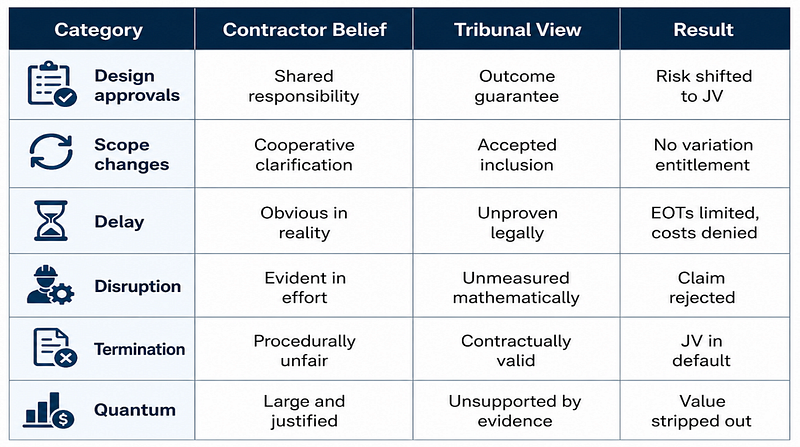
Ultimately, law rewarded discipline, not effort. The employer’s paper trail, and the JV’s omissions, decided everything.
10.7 Primary Sources for Further Reading
1. Obrascon Huarte Lain SA (t/a OHL Internacional) & Contrack (Cyprus) Ltd v Qatar Foundation for Education, Science and Community Development
[2019] EWHC 2539 (Comm), Mrs Justice Carr — termination law under Qatari Civil Code bailii.org
2. Obrascon Huarte Lain SA v Qatar Foundation
[2020] EWHC 1643 (Comm), Mr Justice Butcher — Addendum and correction under ICC Rules Art 35 knyvet.bailii.org
3. Press disclosure: Orascom Construction Newsroom — “Award in the Sidra Project Arbitration” (1 July 2025) orascom.com
These open‑access sources allow any reader to verify every factual and procedural finding described in this book.
10.8 Closing Note — The Real Loss
Sidra was not lost in 2025; it was lost in 2011‑2014, inside design meetings, programme updates, and correspondence chains that looked harmless at the time.
It was not a failure of advocacy, but of record‑keeping, notification, and contractual discipline.
Once those daily decisions were made, the tribunal’s outcome was inevitable.
PART VII — LESSONS FOR CONTRACTORS
9.1 Why Sidra Is Not an “Extreme” Case
Many contractors read large arbitrations and think:
“This only happens on mega-projects.”
That is dangerous thinking.
Sidra is extreme in size, not in structure.
The same patterns appear on:
- hospitals
- data centres
- rail projects
- high-spec commercial developments
Only the numbers change.
9.2 The Illusion of Control During Delivery
One of the hardest lessons from Sidra is this:
A project can look under control operationally while being out of control legally.
At Sidra:
- work continued
- problems were solved
- recovery was ongoing
But legal position was eroding silently.
By the time arbitration began, many outcomes were already fixed.
9.3 The Cost of “Being Reasonable”
Contractors are often proud of being reasonable.
They:
- cooperate
- absorb issues
- avoid confrontation
- keep the project moving
Sidra shows the cost of this approach.
Reasonableness without reservation is interpreted as acceptance.
Tribunals reward clarity, not goodwill.
9.4 Why Most Claims Fail Quietly
Most claims do not fail because they are dishonest.
They fail because:
- notices are weak
- records are incomplete
- decisions are undocumented
- assumptions are implicit
Sidra shows that failure is usually administrative, not technical.
9.5 The Real Skill Contractors Must Develop
The key skill is not:
- arguing better later
- hiring better lawyers later
- preparing bigger claims later
It is protecting entitlement during delivery.
This means:
- documenting disagreement early
- reserving rights consistently
- separating effort from entitlement
- understanding how tribunals think
Sidra is a warning of what happens when this skill is missing.
CLOSING REFLECTION
A Different Path Exists
Sidra Hospital was not doomed from the start.
At many points, different decisions could have preserved legal leverage:
- clearer reservations
- firmer scope control
- disciplined recovery
- stronger termination responses
None of these required conflict.
They required awareness.
This book does not suggest contractors should fight more.
It suggests they should protect themselves better.
Arbitration does not reward heroics.
It rewards discipline.
A different path exists — but only if it is chosen early.
APPENDICES
APPENDIX A — ARBITRATION FACTS AND CASE DETAILS
The Sidra Hospital project was awarded in 2009 under a fixed-price design-and-build contract between Qatar Foundation for Education, Science and Community Development and a joint venture led by Obrascon Huarte Lain S.A. and Contrack Cyprus Limited.
The reported contract value was approximately £1.9 billion. The contract was governed by Qatari law and provided for arbitration under the ICC Rules.
The contract was terminated in July 2014. Performance and advance payment guarantees were called. Arbitration followed, involving multiple partial awards and a final award issued in 2025, later corrected by addendum.
APPENDIX B — KEY EVENTS TIMELINE
- 2009 — Contract award
- 2010–2013 — Design development, coordination, scope evolution
- 2014 — Termination and calling of guarantees
- 2014–2024 — Arbitration proceedings and partial awards
- July 2025 — Principal award issued
- December 2025 — Correction addendum issued
APPENDIX C — FACT CHECKLIST & QUICK REFERENCE: WHY CLAIMS FAIL
Project: Sidra Hospital Complex, Doha, Qatar
Contract Value: ~£1.9 billion
Governing Law: Qatari law
Arbitration: ICC
Claims:
Employer claims >€950 million
JV counterclaims ~€329 million (reported)
Outcome:
Original net award: ~QAR 104.6 million
Corrected net award: ~QAR 3.8 million
Claims usually fail because:
- scope is absorbed quietly
- delay causation is blurred
- disruption is unmeasured
- recovery destroys entitlement
- termination becomes defensible
- records favour the employer
Sidra demonstrates every one of these failure modes.
End Of The E-Book.