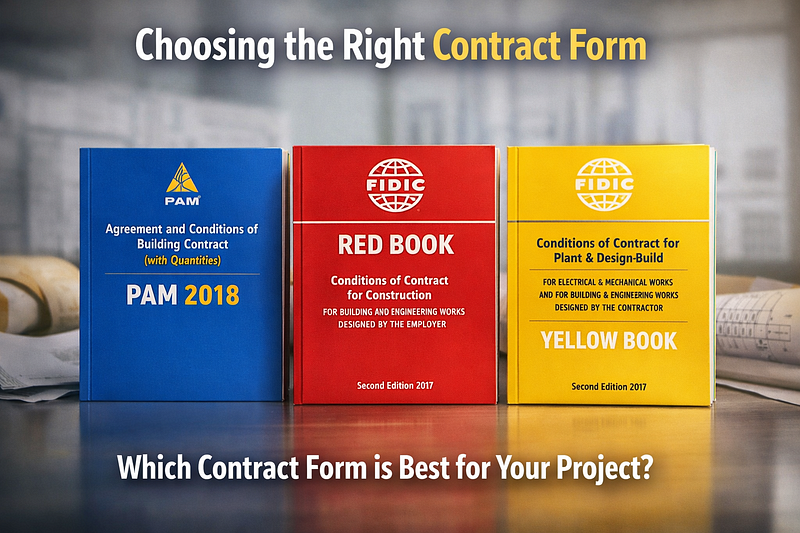
PAM 2018 (With Quantities) vs FIDIC Red Book 2017 vs FIDIC Yellow Book 2017
A Practical 3-Form Comparison Guide
Foreword — Standard Forms — Where Risk Is First Decided
Before any work begins, risk has already been allocated.
This allocation happens through the choice of contract form.
Under PAM 2018 and the FIDIC Red Book, the employer carries the design responsibility.
Under the FIDIC Yellow Book, that responsibility shifts to the contractor.
This single distinction changes everything.
Take a design error.
Under PAM or Red Book:
- The contractor may be entitled to claim
Under Yellow Book:
- The contractor bears the risk
This is not a minor variation.
It determines:
- Who carries liability
- Who bears cost
- Who absorbs delay
And yet, many professionals only begin to analyse risk after the contract is signed.
By then, the most important decision has already been made.
The form of contract is not administrative —
it is the first and most fundamental allocation of risk.
Executive Summary
When these three forms are placed side by side, the real difference is not merely drafting style or clause length. The deeper distinction lies in where risk sits, how decisions are administered, and what kind of dispute each form naturally produces.
The PAM 2018 (With Quantities) form remains closest to the traditional building contract model. It assumes that the Employer’s professional team carries the design function, and that the Contractor’s principal obligation is to build in accordance with the contract documents. Disputes under PAM therefore tend to arise from valuation, delay, certification, variations, workmanship and payment.
The FIDIC Red Book 2017 preserves the broad logic of the employer-design model, but it overlays that model with a much more structured administrative machinery. Its major feature is not a wholesale shift in technical risk, but a marked increase in procedural discipline. Notices, claims, determinations and time bars are all more formalised. As a result, the Red Book tends to generate disputes not only about what happened on site, but also about whether the contractual procedure was followed properly.
The FIDIC Yellow Book 2017 goes further. It not only tightens procedure, but transfers core responsibility for design, integration and performance onto the Contractor. The dispute environment under the Yellow Book is therefore very different again. It is not simply a Red Book with more design. It is a different risk model, under which the Contractor may be responsible not just for building the Works, but for ensuring that the Works function as intended.
That is why these three forms should not be seen as minor variants of one another. In practical use:
- PAM is generally a contract for building works under consultant-led design.
- Red Book is generally a contract for measured works with stronger procedural control.
- Yellow Book is generally a contract for contractor-designed works, performance-driven delivery and a significantly heavier design liability environment.
That distinction is the starting point for any sensible comparison.
1. Contract Philosophy and Project Delivery Model
The PAM form is rooted in the conventional procurement structure. The design is substantially prepared by the Employer’s consultants, quantities are measured, and the Contractor prices and executes against that framework. The contract administrator, typically the Architect, sits at the centre of administration. This creates a familiar allocation of responsibility: design sits mainly on one side, execution on the other.
The Red Book is closer to PAM than the Yellow Book in this respect. It also assumes that the Employer is providing the design basis and that the Contractor is executing measured works. However, it is far more prescriptive in how the contract is administered. The Engineer plays a stronger procedural role than the PAM Architect, and the claims system is more formalised.
The Yellow Book departs most sharply. Here, the Contractor is expected to design and build the Works in accordance with the Employer’s Requirements. The emphasis is not simply on constructing what is drawn, but on delivering a functioning end product. That introduces a very different project logic. The Contractor is no longer merely a builder. It becomes the design coordinator, systems integrator and, in many cases, fit for purpose performance risk bearer.
In practical terms, PAM is usually the most comfortable form for traditional building projects; the Red Book suits infrastructure and civil works where measurement remains important; the Yellow Book is most suitable where the Employer wants single-point responsibility for design and delivery.
2. Design Responsibility
This is the clearest dividing line between the three forms.
Under PAM 2018, design responsibility generally remains with the Employer’s consultants, save where specific contractor-designed portions are expressly included. The Contractor’s main obligation is to construct in accordance with the contract documents. If there is an error in the design prepared by the Employer’s professional team, the Contractor will often have grounds to say that the issue lies outside its responsibility, subject of course to any duty to warn of obvious discrepancies.
Under the Red Book, the position is still broadly similar, although there may be some elements of Contractor design in particular parts of the Works. But the Red Book is not, in its essential structure, a design-and-build form. Its primary burden on the Contractor is still execution rather than full design responsibility.
Under the Yellow Book, by contrast, design responsibility is central. The Contractor is responsible for preparing the design, coordinating the disciplines, developing the proposal into a workable design solution, and delivering a completed facility that meets the Employer’s Requirements. That is not merely an increase in drafting length. It is a structural reallocation of risk.
For that reason, the movement from PAM to Red Book is an administrative shift. The movement from PAM or Red Book to Yellow Book is a commercial and technical risk shift.
3. Fitness for Purpose and Performance Risk
PAM is generally more comfortable with the language of compliance, workmanship and contractual completion. Unless amended, it does not usually impose the same broad, contractor-facing fitness-for-purpose burden that is often associated with design-build contracts.
The Red Book does not usually take the Contractor fully into a pure fitness-for-purpose world either, although the drafting in the 2017 editions is more developed and obligations relating to design portions can be stricter than under PAM.
The Yellow Book is where this issue becomes central. Because the Contractor undertakes the design and is responsible for meeting the Employer’s Requirements, disputes often arise not simply over whether the Works were built, but whether they work, perform, and achieve the required output. This is particularly important in process plants, M&E-heavy projects, utility systems, transport systems and specialist facilities.
That difference has major insurance and pricing consequences. A contractor accustomed to PAM may think in terms of building liability. A contractor under the Yellow Book must think in terms of design liability, integration liability and performance liability together.
4. Contract Administration
PAM remains comparatively more discretionary in tone. The Architect administers, certifies and decides many matters, but the machinery is generally less elaborate than under the 2017 FIDIC forms. That does not mean PAM is simple. It means that the contract still leaves more room for professional judgment and practical administration.
The Red Book 2017 sharply increases the administrative burden. Notices are more formal. Claims are more structured. The Engineer’s determination process is more detailed. Deeming provisions and procedural deadlines appear more frequently. This creates greater certainty for some users, but it also means that a party can lose a good substantive position through poor administration.
The Yellow Book adopts the same procedural architecture, but overlays it onto a technically more complex project environment. This means that administrative failure under the Yellow Book is often compounded by technical complexity. The claim is not only late; it may also relate to a design-development issue, a test failure, a coordination breakdown or a performance dispute.
In real-world terms, PAM may forgive imperfect administration more readily. FIDIC 2017 is far less forgiving, especially the further one moves toward the Yellow Book.
5. Notices and Time Bars
This is one of the most important practical differences.
Under PAM, notice requirements matter, but they do not typically operate with the same degree of fatal consequence that is seen in the 2017 FIDIC regime. Many PAM disputes still end up being argued on their underlying merits, even where the paperwork has been imperfect.
Under the Red Book, strict compliance becomes much more important. The Contractor and Employer alike are drawn into a claims system with defined notice periods, detailed submissions, and procedural consequences for failure. Contract administration becomes a live risk in its own right.
Under the Yellow Book, the exact same procedural burden applies, but it does so in a context where the underlying issues may surface gradually. Design inadequacies, interface failures and performance issues do not always appear in a single obvious moment. That makes notice discipline even more critical, because the question of when a party became aware, or should have become aware, of the relevant event becomes highly contentious.
The practical lesson is straightforward. A team that can survive administratively under PAM may still struggle badly under Red Book 2017. A team that struggles under Red Book administration is likely to be exposed even more severely under the Yellow Book.
6. Variations
PAM deals with variations in a way familiar to the building industry. The valuation framework is recognisable, and the machinery, while important, is generally less procedural than the FIDIC 2017 forms.
The Red Book continues to operate comfortably within a variation-based environment, but the process is more detailed. The Contractor may be required to provide fuller particulars of time and cost effect, and the procedural trail becomes more significant.
The Yellow Book introduces additional complication because variation is no longer just a matter of changed work quantity or revised drawing detail. A variation may cut directly into the design basis, performance criteria, testing requirements or systems integration. As a result, what appears to be a small change instruction may have disproportionately large downstream consequences.
That is why variation disputes under PAM are often valuation disputes, under Red Book they are valuation-plus-procedure disputes, and under Yellow Book they may become valuation-plus-procedure-plus-design/performance disputes.
7. Extension of Time
PAM’s extension of time regime is familiar and comparatively practical for traditional building disputes. Delay events are assessed through the contract administrator, and although disputes do arise, the underlying structure is recognisable to most contractors and consultants in the building sector.
The Red Book refines and formalises the delay process. The Contractor’s entitlement to extension of time becomes more closely tied to proper notices, substantiation and procedural compliance. There is greater precision, but also greater exposure if deadlines are missed.
The Yellow Book adds another layer. Delay may arise not only from physical site conditions or Employer interference, but from design development, design approval cycles, procurement of specialist systems, testing failures and interface issues between design and execution. The delay analysis becomes more sophisticated and often more contentious.
This means that while all three forms deal with delay, they do not generate the same kind of delay dispute. PAM delay disputes are often factual and site-driven. Red Book delay disputes are more procedural. Yellow Book delay disputes are frequently hybrid disputes, involving design, sequencing, testing and notice issues at the same time.
8. Testing, Completion and Taking Over
Under PAM, completion is largely approached through the language of practical completion. The question is whether the Works are substantially complete, subject to minor defects and omissions.
Under the Red Book, Taking Over is more formalised, but still generally sits within a build-complete framework.
Under the Yellow Book, completion is frequently inseparable from testing and performance. The Works may not be regarded as ready for Taking Over until testing on completion has been successfully passed. This creates a much more demanding completion environment. The project is not complete merely because it is built. It must work in accordance with the contract.
This becomes especially important in technically complex projects. A building may look complete, but if the chilled water system, electrical redundancy logic, plant output or automation sequence does not perform as required, the Contractor may remain exposed under the Yellow Book in a way that would not arise under PAM.
9. Role of the Contract Administrator
PAM places the Architect in the familiar contract administrator role, with the quantity surveyor and other consultants supporting particular functions. This is well understood in building projects and, for better or worse, operates within a long-established culture of certification and assessment.
The Red Book gives the Engineer a more formalised decision-making role, especially under the enhanced determination provisions. The Engineer is expected to act in accordance with a more structured process and under a tighter procedural discipline.
The Yellow Book uses the same Engineer-based structure, but because the underlying subject matter is more technical and performance-driven, the Engineer’s determinations are often more exposed to challenge. Questions of design adequacy, interpretation of the Employer’s Requirements, and success or failure in testing can become highly contentious. The Engineer is therefore not just managing quantities or progress, but often sitting at the centre of deep technical disputes.
10. Nature of Typical Disputes
This is where the practical contrast becomes most visible.
Under PAM, the typical dispute is still likely to concern one or more of the following: delayed possession, extension of time, valuation of variations, defective workmanship, certification, set-off and final account.
Under the Red Book, those subjects remain relevant, but disputes increasingly include procedural arguments: whether notice was valid, whether a claim was time-barred, whether the Engineer’s determination was issued in time, whether a submission was sufficiently detailed, and whether a deeming consequence has been triggered.
Under the Yellow Book, disputes expand further into areas such as: whether the Employer’s Requirements were clear, whether the Contractor assumed the relevant design risk, whether the system is fit for purpose, whether the tests were properly conducted, whether performance criteria were achieved, and whether a design-development issue was in truth a variation or a contractor risk.
So while the three forms may share a family resemblance in clause structure, they do not produce the same dispute culture.
11. Which Form Creates the Greatest Exposure?
For a contractor accustomed to traditional building work, PAM is usually the most commercially familiar and administratively manageable of the three.
The Red Book may appear at first glance to be only a modest step away from PAM, but that can be misleading. The procedural discipline required under the 2017 edition is materially more demanding. Teams that fail to adapt their notice, records and claims systems can find themselves exposed very quickly.
The Yellow Book presents the greatest overall exposure, not necessarily because every clause is harsher, but because the risk categories begin to overlap. Design risk, programme risk, testing risk, performance risk and procedural risk can all combine in a single dispute. That makes the consequences of poor tender review, weak design coordination or weak contract administration much more severe.
Closing Observation
If PAM, Red Book and Yellow Book are viewed simply as three standard forms, their real commercial effect will be underestimated.
PAM remains essentially a traditional building contract, even if modified in practice.
The Red Book is a traditional works contract administered through a much tighter procedural regime.
The Yellow Book is a contractor-design contract in which procedure and technical responsibility are both elevated.
Accordingly, the real progression across the three forms is this:
- From PAM to Red Book: the main shift is from practical administration to procedural administration.
- From Red Book to Yellow Book: the main shift is from procedural execution risk to combined procedural and design-performance risk.
That is why users who move between these forms without adjusting their project controls, design review discipline and claims management systems often find themselves in difficulty. The wording may look familiar. The risk environment is not.
Dispute Trigger Map
PAM 2018 (With Quantities) vs FIDIC Red Book 2017 vs FIDIC Yellow Book 2017
A Practical Guide Across All 3 Forms
Executive Summary
When viewed through the lens of dispute generation rather than mere clause comparison, the three forms reveal very different pressure points.
Under PAM 2018, disputes usually arise from the traditional friction points of construction projects: delay, variations, certification, payment, defects and final account closure. The structure is familiar, and although disagreements can be serious, they are often disputes of substance rather than disputes driven by procedural default.
Under FIDIC Red Book 2017, many of those same substantive disputes remain, but they are overlaid with a much tighter contract administration regime. The dispute trigger is therefore no longer confined to what happened on site. It increasingly includes whether notices were issued correctly, whether claims were submitted in time, and whether the Engineer’s determination machinery was properly engaged.
Under FIDIC Yellow Book 2017, the dispute field broadens even further. The same procedural discipline applies, but it does so in a contract where the Contractor also bears primary responsibility for design, coordination, testing and performance. This means that disputes are often not isolated. A single issue may involve design risk, delay consequences, testing failure and notice compliance all at once.
Accordingly, the dispute trigger map across the three forms is not merely a ranking exercise. It is a way of understanding what each form is naturally inclined to produce in practice.
For ease of application, the risk levels below are expressed as:
- Red — likely and serious dispute trigger
- Yellow — moderate but recurring concern
- Green — lower concern or more manageable within the form
1. Design Responsibility
This is one of the clearest dividing lines across the three forms.
Under PAM 2018, design is generally retained by the Employer’s consultants. The Contractor may have limited design responsibility for specialist portions, but the form itself is not built around single-point design responsibility. Disputes can still arise where the Contractor builds something defective or fails to warn of obvious discrepancies, but the baseline position is relatively stable. The dispute trigger level here is generally Green to Yellow, depending on the extent of any contractor-designed portion.
Under the Red Book 2017, the position remains broadly employer-design in character, though certain design elements may still sit with the Contractor. This creates more room for dispute than under PAM, but design is still not the central battlefield of the form. The trigger level is usually Yellow rather than Red.
Under the Yellow Book 2017, however, design responsibility is fundamental. The Contractor is not simply executing drawings. It is expected to interpret the Employer’s Requirements, develop the design, coordinate disciplines and deliver a completed facility that satisfies the contract criteria. This creates a classic Red trigger. In practice, many Yellow Book disputes begin with a disagreement over where the design obligation started, how far it extended, and whether the Contractor assumed responsibility for an inadequacy embedded in the original requirements.
2. Fitness for Purpose and Performance Obligations
Under PAM, the Contractor’s obligations are generally more closely tied to compliance with the contract documents, proper workmanship and satisfactory completion. The contract does not usually push the Contractor into a broad performance-guarantee environment unless amended to do so. As such, this is usually a Green trigger, becoming Yellow only in specialist projects or heavily amended forms.
Under the Red Book, performance issues can still arise, particularly where there are contractor-designed elements or testing requirements, but the form is not as heavily centred on strict performance delivery as the Yellow Book. The trigger here is generally Yellow.
Under the Yellow Book, by contrast, fitness for purpose and performance are central sources of dispute. The question is not merely whether the Works have been built, but whether they perform as required by the Employer’s Requirements. That makes this a strong Red trigger. It is especially important in M&E-heavy projects, plants, utilities, systems-based works and technically integrated assets. Many of the most expensive disputes under design-build forms arise not from visible defect, but from failure to achieve required functional output.
3. Employer’s Requirements / Contract Documents Ambiguity
PAM relies on drawings, bills, specifications and consultant-issued contract documents. Ambiguities certainly generate dispute, but the responsibility for design interpretation remains more distributed. The trigger level is generally Yellow.
Under the Red Book, the issue remains significant, particularly where the Employer’s design information is incomplete or coordination between documents is poor. However, because the Contractor is not usually carrying the same full design burden as under Yellow Book, the trigger is still generally Yellow rather than Red.
Under the Yellow Book, ambiguity in the Employer’s Requirements is a major dispute engine. The Contractor is expected to price, design and perform against those requirements, yet many requirements documents are aspirational, incomplete or internally inconsistent. This immediately creates a Red trigger. Disputes often arise over whether the requirement was sufficiently clear, whether the Contractor ought to have priced for it, and whether a later clarification is in fact a variation or merely an insistence on what was always required.
4. Variations
Variations under PAM are a familiar feature of building contracts. The usual disputes concern valuation, omission, late instruction, or whether something is truly a variation at all. These are common but generally manageable within the form. The trigger level is usually Yellow.
Under the Red Book, variations become more procedurally sensitive. The distinction between variation by instruction and proposal-based change, together with the need for more detailed submissions on time and cost effect, can turn variation administration into a more active dispute zone. This makes the Red Book variation trigger Yellow edging toward Red where administration is poor.
Under the Yellow Book, the variation issue becomes more complex. A change may affect not only quantities or scope, but design development, systems integration, procurement, testing and performance. Even a seemingly modest adjustment can ripple across the design basis. Accordingly, the dispute trigger is often Red. Many Yellow Book disputes begin as variation valuation disagreements but quickly widen into questions of design responsibility and performance impact.
5. Extension of Time and Delay Events
PAM has a familiar delay landscape. The main questions usually concern whether the event falls within the EOT machinery, whether the Architect granted sufficient time, and whether loss and expense follows. This remains a significant dispute area, but it is a conventional one. The trigger level is generally Yellow.
The Red Book makes delay more procedurally demanding. Entitlement depends much more clearly on notice, substantiation and compliance with the claims framework. Delay disputes therefore become both factual and procedural. The trigger level is generally Red.
Under the Yellow Book, delay analysis becomes even more layered. Delay may arise from design development, approval cycles, procurement of specialist systems, interface failures and testing shortfalls, in addition to ordinary construction events. This makes delay one of the most powerful Red triggers under the Yellow Book. It is not merely that delay happens more often. It is that the analysis becomes harder, more technical and more exposed to claims failure if the contractual steps are not followed.
6. Notice Provisions and Time Bars
This is one of the most important practical distinctions between the forms.
Under PAM, notices matter, but imperfect notice does not usually destroy entitlement with the same immediacy seen in FIDIC 2017. Courts and tribunals often still examine the substantive merits. For that reason, this trigger is usually Yellow, not Green, because notice failures can still hurt a party, but they are not usually as fatal.
Under the Red Book 2017, notice and time bar provisions become a major source of dispute in their own right. Claims that may be factually strong can fail because the Notice of Claim or subsequent particulars were late or incomplete. This is plainly a Red trigger.
Under the Yellow Book, the same strict machinery applies, but it interacts with technically evolving issues. Because design and performance problems do not always emerge in a single clear event, arguments over when the notice clock started are common. This is therefore also a Red trigger, and in practical terms often an even more volatile one than under the Red Book.
7. Programme and Progress Monitoring
Under PAM, the programme is important, but it does not always sit at the centre of legal entitlement in the same way. Disputes arise, but the programme is often one evidential tool among several. The trigger level is typically Green to Yellow.
The Red Book gives the programme a more formal administrative role. The content requirements are more detailed, and the relationship between programme updates, delay analysis and claims becomes more direct. This creates a Yellow trigger, becoming Red on heavily managed infrastructure projects.
Under the Yellow Book, the programme is not just a construction schedule. It is also a design, procurement, testing and commissioning roadmap. That makes programme failure much more dangerous. The trigger is therefore Yellow edging toward Red, especially where long-lead equipment or integrated systems are involved.
8. Testing, Commissioning and Completion
Under PAM, practical completion is still the dominant concept. Disputes arise over whether completion has been achieved, but the test is usually centred on substantial completion rather than full operational performance. This area is usually Yellow.
Under the Red Book, taking-over is more formalised, but the overall dispute profile still sits closer to build completion than operational performance. The trigger is generally Yellow.
Under the Yellow Book, testing and commissioning are among the strongest dispute triggers in the entire contract. Completion may depend on successful testing, and testing may in turn expose design, coordination or performance deficiencies. This is a classic Red trigger. Where projects involve process performance, systems integration or specialist output standards, this can become the central dispute zone.
9. Certification, Determinations and Role of Contract Administrator
Under PAM, the Architect’s certification role remains an established source of dispute, especially in relation to payment, EOT and completion. Yet the structure is relatively familiar, and the contract does not usually drive immediate procedural escalation in the same way. This remains a Yellow trigger.
The Red Book strengthens the Engineer’s role and gives much more procedural detail to the determination process. If the Engineer does not act in time or in accordance with the contractual mechanism, dispute escalation may follow quickly. This is a Red trigger.
Under the Yellow Book, the Engineer’s role becomes even more exposed because the subject matter of the determination is often more technical. The Engineer is not merely assessing progress or valuation, but sometimes making judgments that go to design adequacy, interpretation of requirements, testing compliance and performance achievement. This is also a Red trigger.
10. Payment, Final Account and Finality
PAM disputes on payment remain common: interim certificates, set-off, withholding and final account closure all continue to generate friction. But the dispute generally remains substantive. The trigger is usually Yellow.
Under the Red Book, payment disputes become more procedural, especially where final statements, final payment certification and challenge periods are tightly governed. The introduction of deeming consequences for failure to challenge in time makes this a Red trigger.
Under the Yellow Book, the same procedural structure applies, but final account disputes can also include unresolved design-development and performance matters. That means the financial closure of the project may be delayed or complicated by wider technical disputes. This remains a Red trigger.
11. Defects and Post-Completion Liability
Under PAM, defects disputes are common but familiar. The focus is usually on whether the defect arose from poor workmanship, materials, or incomplete work. The trigger level is generally Yellow.
Under the Red Book, defects remain important, though the allocation may become more nuanced where design portions are involved. The trigger is also generally Yellow.
Under the Yellow Book, defects are often harder to isolate because what is called a defect may in truth be a design inadequacy, a systems integration failure, or a performance shortfall. The defect regime therefore becomes more technically charged, and the trigger level is often Red in complex projects.
12. Dispute Escalation Path
PAM typically moves toward arbitration or adjudication through more familiar construction dispute routes. The escalation path is comparatively straightforward. The trigger level here is generally Green to Yellow.
The Red Book introduces a more structured path through the Engineer’s determination and then the DAAB process. This can be useful, but it also creates procedural choke points. If a party misses a step, or if the step itself becomes disputed, escalation becomes more complicated. The trigger level is Yellow.
Under the Yellow Book, that same path exists, but the disputes themselves are often more technically involved and harder to compartmentalise. The trigger remains Yellow, with the practical burden often higher than under the Red Book even if the formal structure is similar.
Overall Dispute Trigger Position Across the 3 Forms
If the forms are looked at from the standpoint of likely dispute intensity, a practical pattern emerges.
PAM 2018 (With Quantities) is still the most familiar and generally the most manageable for traditional building projects. Its main dispute triggers are delay, variations, certification, payment and defects. These are serious, but usually recognisable and capable of being argued on substantive grounds.
FIDIC Red Book 2017 introduces a much sharper procedural edge. The main intensifier of dispute is not necessarily greater technical complexity, but a much stronger risk of losing entitlement through administrative failure. Delay, variation and payment disputes remain, but they become more dangerous because of the claims machinery wrapped around them.
FIDIC Yellow Book 2017 presents the heaviest overall dispute profile. It combines the procedural strictness of the 2017 FIDIC regime with primary Contractor design responsibility, testing obligations and performance risk. As a result, dispute triggers are more likely to overlap and reinforce one another.
That progression can be expressed plainly:
- Under PAM, disputes are mainly about execution and valuation.
- Under Red Book, disputes are about execution, valuation and procedure.
- Under Yellow Book, disputes are about execution, valuation, procedure, design and performance together.
Closing Observation
A dispute trigger map is useful only if it changes behaviour.
For parties operating under PAM, the main discipline remains strong project administration, timely certification, records and valuation control.
For parties operating under the Red Book, that is no longer enough. They must also run a disciplined notice and claims system, because administrative omission can become as dangerous as physical delay.
For parties operating under the Yellow Book, the discipline must go further still. Design review, requirements analysis, interface management, testing strategy and claims administration must all be integrated from the outset. Otherwise, the contract’s red zones will not remain isolated. They will combine.
That is the real lesson across the three forms: the further one moves from PAM toward Yellow Book, the less possible it becomes to separate technical management from contractual management.
Project-Type Application View
PAM 2018 (With Quantities) vs FIDIC Red Book 2017 vs FIDIC Yellow Book 2017
A Practical Portrait Guide Across All 3 Forms
Executive Summary
Choosing between PAM 2018, FIDIC Red Book 2017 and FIDIC Yellow Book 2017 is not merely a matter of style or institutional preference. It is fundamentally a question of project fit.
A form may be well drafted in the abstract and yet still be poorly suited to the project it is being used for. Many disputes arise not because the contract is defective, but because the contract was selected for a delivery model it was never truly designed to support. In practice, the issue is often not whether PAM, Red Book or Yellow Book is “better,” but whether the selected form aligns with the project’s design structure, procurement strategy, technical complexity, performance expectations and risk appetite.
Broadly speaking, PAM 2018 is most comfortable where the project follows a traditional building procurement model, with consultant-led design and a contractor principally responsible for execution. The Red Book fits projects where the design remains substantially on the Employer’s side, but where the scale, infrastructure character or administrative discipline of the project calls for a more structured engineering contract. The Yellow Book is most suitable where the Employer seeks single-point responsibility for design and delivery, especially where performance outcomes matter as much as physical completion.
That said, project reality is rarely neat. Many projects sit somewhere between forms. A building project may contain heavy M&E systems that begin to resemble a performance-based plant contract. An infrastructure project may be procured under employer design but later behave like a design-build job in everything but name. A contractor may inherit design coordination burdens even where the form does not openly say so.
That is why this application view matters. It helps identify not just what each form says, but where each form works best, where it starts to strain, and where it is likely to generate mismatch-driven dispute.
1. Traditional Building Projects
For conventional building projects such as residential towers, commercial offices, schools, hotels and standard institutional developments, PAM 2018 generally remains the most natural fit.
The reason is straightforward. These projects are commonly procured on the basis that the Employer’s consultants prepare the design, quantities are measured, and the contractor builds what is documented. The main contractual pressure points tend to concern progress, variations, workmanship, extension of time, certification and final account. PAM is structurally comfortable with this environment. Its language, administration model and allocation of responsibility are all familiar to the traditional building sector.
The Red Book can also be used for such projects, but it often introduces a level of procedural machinery that may exceed what the project truly requires. Where parties are well resourced and want a tighter claims environment, that may be acceptable. However, for ordinary building projects, the Red Book can sometimes feel administratively heavier than necessary.
The Yellow Book is generally less natural for a traditional building project unless the Employer genuinely intends to shift design responsibility to the Contractor. If used in a standard building context without that intention being fully understood, it can create unnecessary design and performance disputes. In other words, a conventional building project placed under the Yellow Book may begin to behave like a design-build project even where the parties are not operationally ready for that shift.
In practical terms:
- PAM is usually the best fit for traditional building projects.
- Red Book may be workable but often more procedural than needed.
- Yellow Book should be used carefully and only where contractor design is truly intended.
2. Civil Engineering and Infrastructure Works
For roads, bridges, tunnels, pipelines, earthworks, drainage systems and other civil infrastructure projects, the Red Book generally has a stronger natural fit than PAM.
This is because such projects often involve substantial measurement, evolving site conditions, engineering-driven administration and an Employer-design model that still requires structured management of quantities, variations and delay. The Red Book was designed for this kind of environment. Its Engineer-led administration and claims framework are more at home in infrastructure projects than PAM’s more building-centric administrative culture.
PAM can still be used in some infrastructure-related projects, particularly where the works are building-adjacent or where the local market is deeply accustomed to PAM. But in pure civil works, it may feel less tailored to the realities of site conditions, measurement issues and engineering administration.
The Yellow Book becomes appropriate only where the infrastructure project is genuinely being delivered on a design-build basis. If the Contractor is expected to develop the engineering design, optimise the technical solution and deliver to performance requirements, then Yellow Book may be the better fit. But where the design remains substantially with the Employer, the Yellow Book may transfer more design exposure than the parties intended.
Accordingly:
- Red Book is usually the most natural fit for civil and infrastructure works under employer design.
- PAM may work in some local or hybrid contexts, but is less naturally aligned.
- Yellow Book fits only where true contractor design responsibility is part of the delivery strategy.
3. Design-and-Build Building Projects
Where a building project is procured on a design-and-build basis, the comparison becomes much more delicate.
At first glance, the Yellow Book appears the obvious choice because it is the FIDIC design-build form. In principle, that is correct. If the Employer wants the Contractor to assume primary responsibility for design development, coordination, interface management and functional delivery, then Yellow Book provides a framework better aligned with that intention than PAM or Red Book.
However, not every so-called design-and-build building project is truly ready for Yellow Book discipline. Many building-sector design-and-build arrangements still operate culturally like consultant-led projects, with incomplete Employer requirements, shifting design input from the Employer, and market expectations shaped by traditional building practice. In such cases, the Yellow Book can generate friction if the project team has not fully internalised the risk transfer that comes with it.
PAM may still be used for design-and-build variants in some markets through amendments or supplementary conditions, but once the Contractor is assuming genuine design leadership, the contract must be very carefully adapted. Otherwise, gaps emerge between design responsibility, approval mechanisms and liability structure.
The Red Book is generally the least natural of the three for a true design-and-build building project, because it sits in the middle ground. It may preserve too much employer-design logic while still imposing a heavy procedural framework.
In practice:
- Yellow Book is the clearest fit where the Contractor truly designs and builds.
- PAM can function only if heavily and coherently adapted.
- Red Book is usually less attractive for pure design-build buildings unless the project remains heavily employer-defined.
4. Industrial, Process and Plant-Type Projects
For industrial facilities, utilities, treatment plants, manufacturing lines, energy systems and similar projects where successful performance matters as much as physical completion, the Yellow Book generally becomes the strongest candidate of the three.
These projects are rarely satisfied merely by “substantial completion” in the ordinary building sense. The real question is whether the facility performs: whether the plant outputs, the treatment system processes, the equipment integrates, the controls respond, and the whole installation meets its intended purpose. That is where the Yellow Book has a natural advantage. It is built for a world in which testing, commissioning and performance obligations are central.
PAM is generally less suited to this environment unless the project is relatively simple or the parties are willing to supplement it heavily. Its traditional building-based completion and defects logic may not adequately capture the performance dimension of plant-style projects.
The Red Book may suit some process-related projects where the Employer retains the design and the contractor is principally executing works under engineering administration. But if the Contractor is responsible for selecting, designing or integrating the technical systems, the Red Book may no longer reflect the commercial reality of the project.
So, for plant-type projects:
- Yellow Book is often the most suitable where design, integration and performance are central.
- Red Book may work where the Employer retains the design basis.
- PAM is usually the least naturally aligned unless the project is only lightly process-driven.
5. M&E-Heavy Buildings
This is one of the most important gray zones in practice.
A project may look like an ordinary building on the outside and yet behave contractually like a systems project because of its M&E intensity. Hospitals, airports, laboratories, data-rich office towers, specialist retail facilities, transport hubs and complex hospitality projects often fall into this category. The structural shell may be conventional, but the real operational value of the project lies in systems performance.
PAM can still be used for such projects, especially where the design remains with the consultants and the market expects a traditional building contract. But the heavier the services content, the greater the strain on a purely traditional form. Disputes start to migrate away from basic workmanship and toward coordination, sequencing, integration and commissioning.
The Red Book may provide a stronger administrative platform if the Employer’s consultants are leading the design and the project needs more disciplined claims and determination machinery. It can be particularly useful where the works are engineering-heavy but still employer-designed.
The Yellow Book becomes especially attractive where the Employer wants a single point of responsibility for the functioning of the building systems. If the project turns on whether the chilled water plant, electrical resilience, BMS integration, life safety interfaces or specialist technical spaces perform as required, then a performance-based design-build approach may be more honest to the risk profile.
In summary:
- PAM works best where M&E remains consultant-designed and performance obligations are not aggressively transferred.
- Red Book suits engineering-heavy projects that remain largely employer-designed.
- Yellow Book is strongest where system functionality and contractor-led integration are central.
6. Data Centres and Mission-Critical Facilities
Among all project types, data centres are one of the clearest examples of why contract choice matters.
A data centre is not merely a building. It is a mission-critical environment where value lies in resilience, redundancy, thermal performance, electrical continuity, control integration and operational stability. A project can be physically complete and still commercially unacceptable if the systems do not perform to the required level.
For that reason, Yellow Book often has strong attraction in this sector where the Contractor is expected to take meaningful responsibility for design coordination, systems integration and performance outcomes. The question is not just whether the building is finished, but whether it works in a mission-critical sense.
That said, many data centre projects are delivered through layered procurement structures, with the Employer retaining significant input through specialist consultants, vendors and performance criteria. In that situation, the Yellow Book can still work, but only if the Employer’s Requirements are extremely clear and the interfaces are properly managed. If they are not, the project may become fertile ground for disputes over where Employer criteria end and Contractor design responsibility begins.
The Red Book may be suitable where the Employer wishes to keep firm control of the technical basis and use the Contractor primarily for execution, installation and measured works. But this works best only where the Employer is genuinely equipped to lead the design environment.
PAM is generally the least naturally suited to a fully mission-critical facility unless the project is being delivered in a more traditional consultant-led way and the parties are prepared to manage the system-performance dimension outside the standard PAM structure.
Accordingly:
- Yellow Book is often the most natural fit for contractor-led mission-critical delivery.
- Red Book may work where the Employer retains strong design control.
- PAM may be workable only in more traditional procurement arrangements and usually requires careful supplementation.
7. Residential and Repetitive Development
For ordinary residential developments, especially high-rise residential, landed housing and repetitive building typologies, PAM remains highly effective.
The reasons are practical. The design is usually well developed before tender, repetition reduces technical uncertainty, and the disputes that arise are familiar to building-sector participants. These projects usually do not require the performance-based logic of Yellow Book or the heavy procedural architecture of FIDIC 2017 unless the project is unusually complex.
The Red Book can still be used, but it may impose more claims discipline than the project team is culturally prepared for. This can create disputes that feel artificial or overly procedural in what is otherwise a fairly standard building context.
Yellow Book may be appropriate only where the Employer wants a genuine design-build residential model with substantial contractor-led design responsibility. Even then, care is needed, because many residential projects continue to rely heavily on consultant input and statutory submission frameworks that do not sit neatly with a pure design-build risk transfer.
As a general rule:
- PAM is the most natural fit for ordinary residential development.
- Red Book is possible but often unnecessarily rigid.
- Yellow Book should be used only where design-build responsibility is clearly intended and well managed.
8. Public Sector Projects
Public sector projects introduce another layer to form selection: institutional process, auditability, administrative discipline and policy preference.
PAM is often attractive in public building projects where local industry familiarity, consultant-led design and established building procurement practices remain dominant. Its framework is often easier for a broad range of stakeholders to understand and administer.
The Red Book may be particularly attractive in public infrastructure projects because it offers more formalised procedures, a stronger Engineer-based administrative structure and clearer claim pathways. These features may appeal where documentation, accountability and consistency are especially important.
The Yellow Book may also be used in public sector delivery, especially for utilities, transport systems, treatment plants or specialist facilities where performance is critical and contractor design responsibility is desired. However, this demands a higher level of sophistication in preparing the Employer’s Requirements and managing interface risk. Without that, the public sector Employer may inadvertently buy disputes instead of certainty.
In practical terms:
- PAM often fits public building works.
- Red Book often fits public infrastructure works.
- Yellow Book fits public design-build or performance-critical projects only where the Employer is properly equipped to define requirements with precision.
9. Fast-Track Projects
Fast-track projects test every form because design, procurement and construction begin to overlap more aggressively than usual.
PAM can still be used for fast-track work, but strain appears quickly if the design is incomplete and variation pressure becomes intense. The form can accommodate this, but the project team must be disciplined in instructions, records and valuation.
The Red Book may help where the parties want stronger administrative control over evolving scope and delay consequences. However, its procedural demands can also become burdensome in a genuinely fast-moving environment if the team lacks the resources to keep pace with notice and claim obligations.
The Yellow Book can be suitable for fast-track projects only if the Contractor is truly taking ownership of design development and procurement strategy. If the Employer continues to intervene heavily in the design while the project is moving quickly, the combination can become unstable. Fast-track plus blurred design responsibility is a common recipe for major dispute under design-build forms.
So the key issue is less speed itself and more whether the contract matches the way speed is being achieved.
10. Projects Most Likely to Suffer from Contract Mismatch
Some of the most difficult disputes arise not from projects that clearly belong under one form, but from projects that are procured under a form inconsistent with how they actually operate.
A building project run under PAM but heavily dependent on contractor-led design integration may start to produce Yellow Book-type disputes without having Yellow Book-type risk clarity.
A civil or engineering project procured under Red Book but then informally pushed into contractor design responsibility may create hidden design exposure not properly priced or documented.
A technically complex systems project procured under Yellow Book with poorly developed Employer’s Requirements may push too much uncertainty onto the Contractor, resulting in constant dispute over whether evolving requirements are part of the original bargain or a change.
In each case, the form is not necessarily wrong in the abstract. The real problem is that the project delivery model and the contract no longer match.
That is why the correct question at tender stage is not simply: “Which standard form do we usually use?” It is: “Which form best reflects who is designing, who is coordinating, who is carrying performance risk, and how the project will actually be administered?”
Overall Practical Fit Across the 3 Forms
A practical way of viewing the three forms is this:
PAM 2018 (With Quantities) is strongest where the project is a traditional building job with consultant-led design, familiar valuation issues and ordinary completion expectations.
FIDIC Red Book 2017 is strongest where the project remains substantially employer-designed but needs a more engineering-oriented, procedurally disciplined and infrastructure-suited administration regime.
FIDIC Yellow Book 2017 is strongest where the project is genuinely design-build, system-led, performance-sensitive or dependent on single-point technical responsibility.
None of these forms is universally superior. Each becomes powerful when matched to the right project and risky when stretched too far beyond its natural home.
Closing Observation
Project-type suitability is not a secondary consideration. It is one of the primary determinants of whether the contract will support delivery or become a source of dispute.
PAM works best when the project is fundamentally about constructing a designed building.
Red Book works best when the project is fundamentally about delivering measured engineering works under disciplined administration.
Yellow Book works best when the project is fundamentally about delivering a functioning designed solution, not merely constructing what was drawn.
The closer the contract matches that underlying reality, the more likely the project team will spend its energy on delivery rather than on arguing about where the risk was supposed to sit.