CIPAA remains a statutory adjudication mechanism for payment disputes. However, the Malaysian courts have recognised that an adjudicator cannot properly determine how much is payable without also deciding the underlying contractual and site issues that directly affect that payment.
Those underlying issues may include valuation, variations, certification, defective work, EOT, LAD, delay responsibility, completion dates and certain contractual set-offs. They enter CIPAA because they determine whether payment is due and, if so, how much — not because CIPAA independently adjudicates every construction dispute.
Why this broader practical scope is possible
There are three legal layers.
1. The gateway remains a payment claim
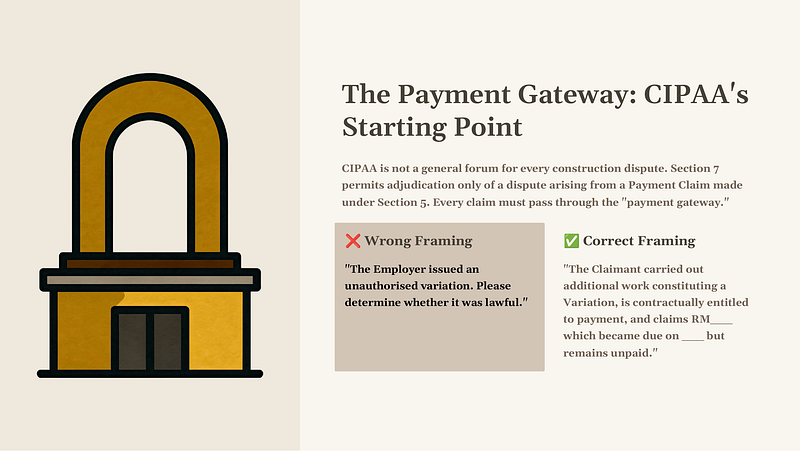
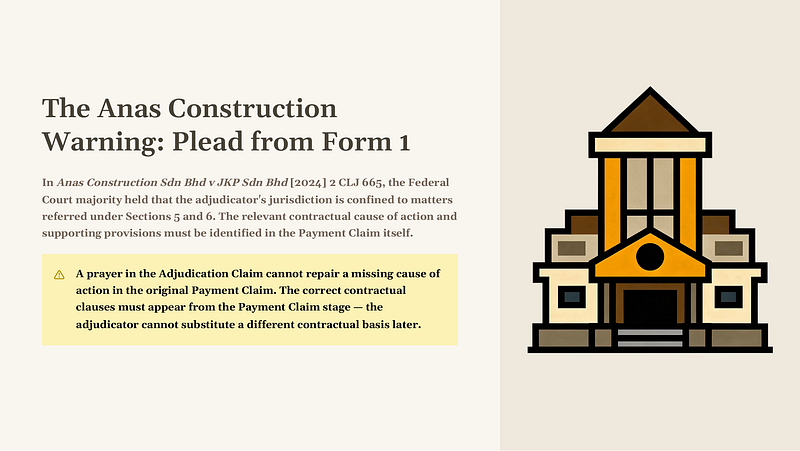
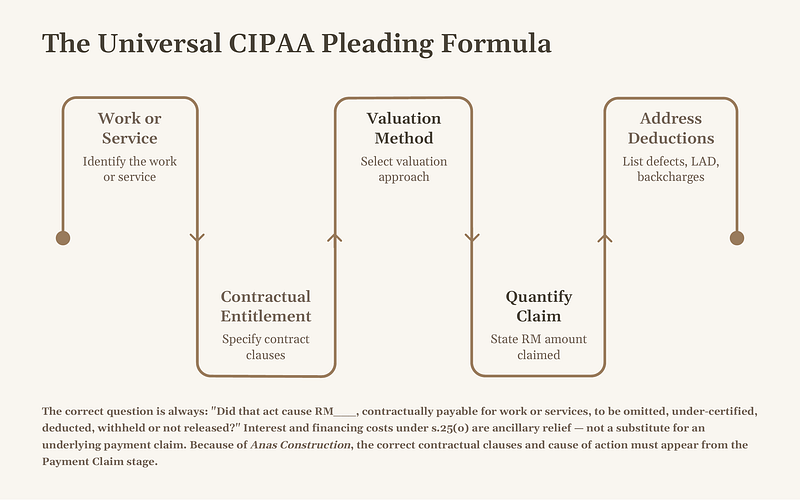
Section 5 requires a claim for payment pursuant to a construction contract. The claim must identify:
- the amount claimed and its due date;
- the contractual cause of action and relevant provision;
- the work or services to which the payment relates; and
- that the claim is made under CIPAA.
Section 7 then allows a dispute arising from that payment claim to be referred to adjudication.
2. The adjudicator has unusually wide valuation powers
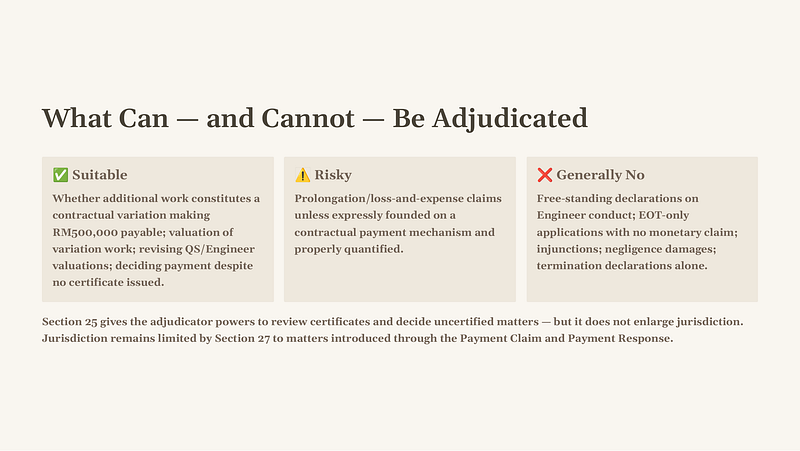
Once a valid payment dispute is before the adjudicator, section 25 permits the adjudicator to:
- inspect the site and open up work;
- ascertain the facts and law inquisitorially;
- review and revise certificates;
- review and revise decisions, instructions, opinions and valuations;
- decide matters even though no certificate has been issued; and
- award interest and financing costs where jurisdiction already exists.
These powers explain why CIPAA is not merely an enforcement process for an existing certificate. It can operate as a temporary statutory valuation and payment-determination process.
3. Incidental issues may have to be decided
A site issue becomes adjudicable when it is inseparably connected with the amount payable. For example:
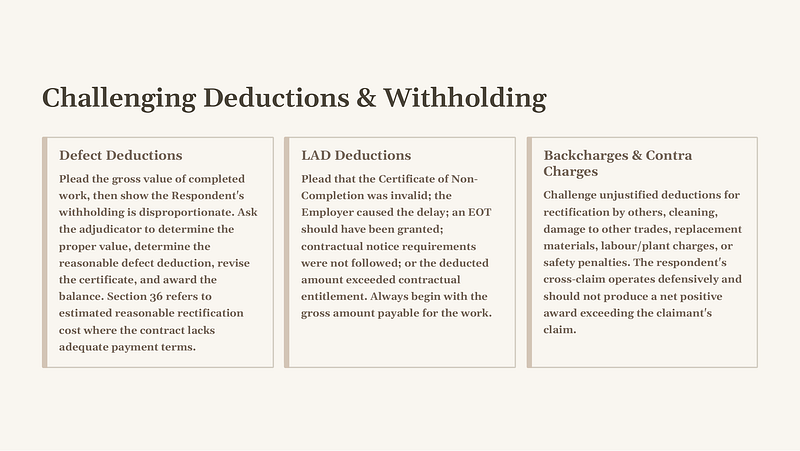
If an employer deducts LAD from the contractor’s progress claim, the adjudicator cannot decide whether the deduction is valid without considering the contractor’s EOT entitlement.
The EOT issue is therefore determined as part of deciding the payment dispute. It is not necessarily a free-standing EOT adjudication.
In PJ Midtown Development v Pembinaan Mitrajaya, relying on authorities including Bertam Development, Asal Construction and SKS Pavilion, the court accepted that once LAD was raised as a set-off, the corresponding EOT issue had to be considered because LAD and EOT were “the flip side of the same coin”.
Matters that can now practically arise in CIPAA adjudication
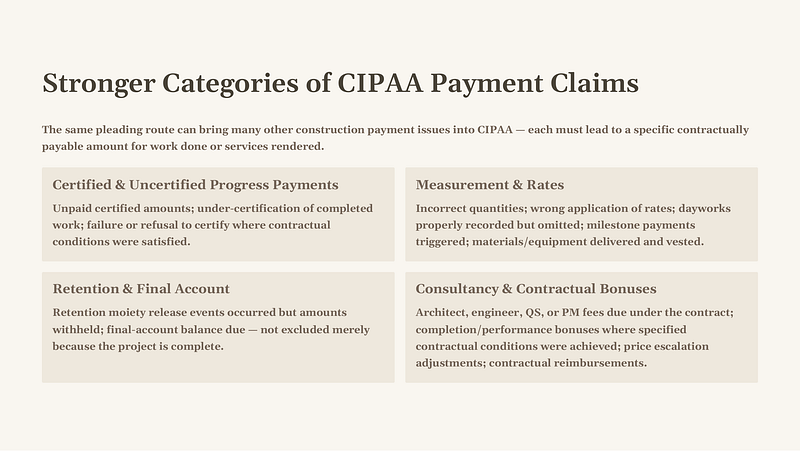
A. Valuation and certification disputes
1. Undervaluation or under-certification
A contractor may contend that the architect, engineer, superintending officer or quantity surveyor:
- undervalued completed work;
- applied the wrong percentage of completion;
- used an incorrect rate;
- omitted measured quantities;
- improperly reduced previously certified work;
- failed to value preliminaries properly;
- wrongly excluded materials delivered to site;
- applied an unjustified discount; or
- made incorrect deductions.
The adjudicator may review and revise the relevant certificate or valuation under section 25(m).
2. Revaluation of completed work
The adjudicator may independently assess:
- actual quantities executed;
- percentage completion;
- applicable contract rates;
- derived or star rates;
- reasonable rates where no applicable rate exists;
- valuation of dayworks;
- valuation of provisional quantities;
- adjustment of prime cost or provisional sums; and
- the proper value of work at termination.
This means a certificate is evidence of valuation, but it is not necessarily conclusive for CIPAA purposes.
3. Non-certification or silence by the contract administrator
The absence of a certificate does not necessarily prevent adjudication. Section 25(n) expressly allows an adjudicator to decide or declare on a matter even where no certificate has been issued.
In Bertam Development, the court accepted that uncertified variation sums could be referred to adjudication. An architect or employer could not simply refuse to certify completed work and then argue that nothing was due because no certificate existed.
4. Wrongful withholding of a certificate
CIPAA may address circumstances where:
- the contract administrator refuses to issue an interim certificate;
- certification is unreasonably delayed;
- the employer interferes with certification;
- items are omitted without reasons;
- certification is made subject to an irrelevant condition; or
- certification is withheld because no formal variation order was issued.
The claimant must still prove the contractual entitlement, work performed, valuation and due date.
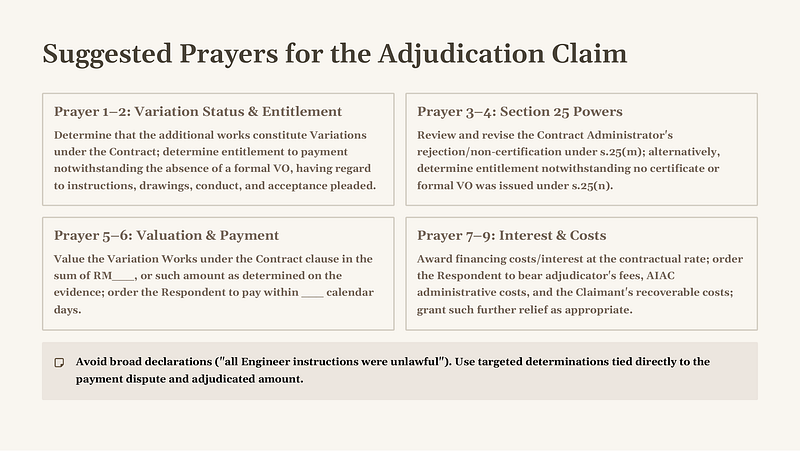
B. Variation and additional-work disputes
5. Certified but unpaid variations
These are straightforward payment disputes where the variation has been valued or certified but remains unpaid.
6. Uncertified variations
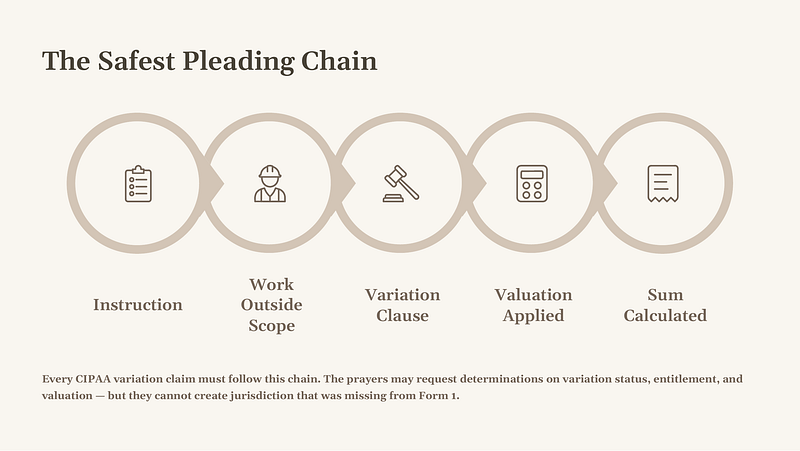
An adjudicator can consider additional work that was executed but not certified, provided the payment claim properly identifies:
- the instruction or conduct giving rise to the variation;
- the contractual provision relied upon;
- the work actually completed;
- the valuation methodology;
- the amount claimed; and
- when payment became due.
Bertam Development is important because it recognised the adjudicator’s ability to determine uncertified variation sums.
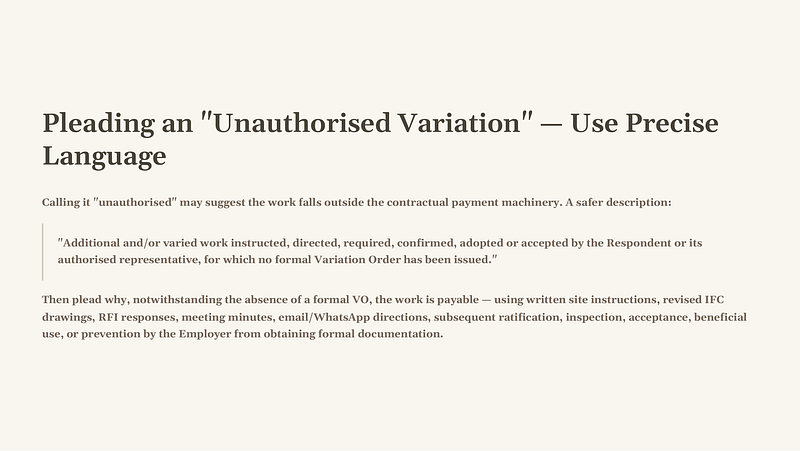
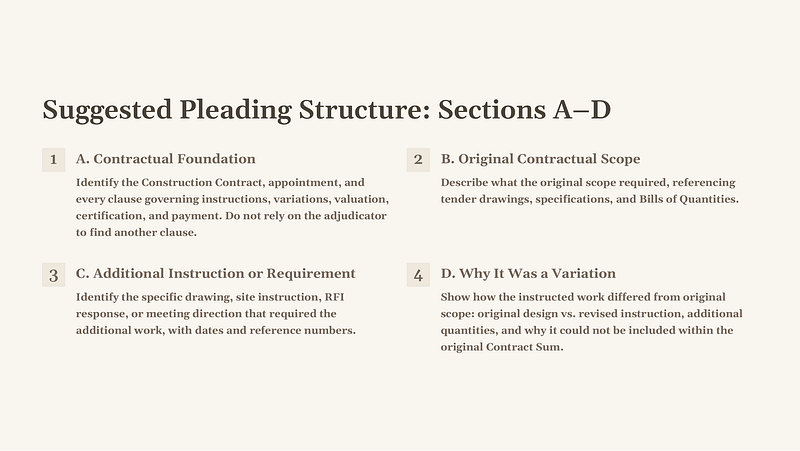
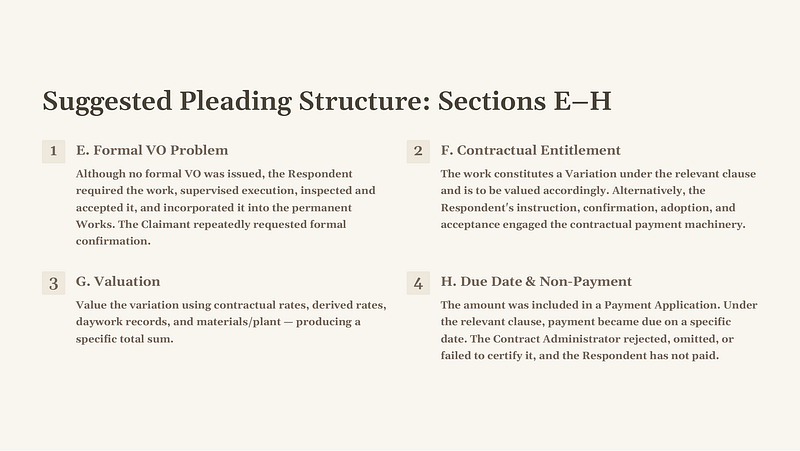
7. Work performed without a formal written variation order
The absence of a formal VO is not automatically the end of the claim. The adjudicator may have to examine:
- drawings issued for construction;
- revised drawings;
- architect’s or engineer’s instructions;
- site instructions;
- requests for information and replies;
- meeting minutes;
- emails and correspondence;
- approvals of samples or shop drawings;
- measurement records;
- whether the employer knew of and accepted the work;
- whether the work was necessary to complete the instructed design; and
- whether contractual notice or written-instruction requirements were satisfied, waived or otherwise answered.
However, CIPAA does not abolish contractual conditions precedent. A claimant must confront any provision requiring written instructions, notice or contemporaneous particulars.
8. Disputed valuation methodology for variations
The adjudicator may decide whether a variation should be valued using:
- existing contract rates;
- analogous rates;
- adjusted rates because the character or conditions changed;
- fair market rates;
- quotations and invoices;
- actual cost plus contractual mark-up; or
- daywork records.
9. Omitted work and negative variations
An adjudicator may determine whether an omission or deduction was valid and its correct value, especially where it affects the net amount payable.
 Page 1
 Page 2
 Page 3
 Page 4
 Page5
Page5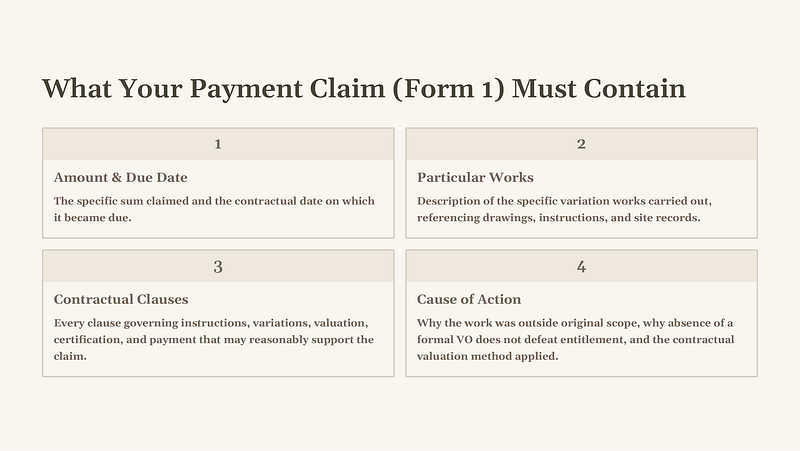 Page 6
 Page 7
 Page 8
 Page 9
 Page 10
 Page 11
 Page 12
 Page 13
 Page 14
 Page 15