Why Data Centres Are Fertile Ground for Construction Disputes — and How Contractual Preparedness Stops Them Before They Escalate into Arbitration
Are Your Notices, Variations and Payment Claims Properly Protected?
Download the free Construction Contract Risk Protection Pack and check whether your project records and contractual procedures are protecting your entitlement.
Send It to Me
In January 2026, Chin Hin Group Berhad announced that its subsidiary, Kayangan Kemas Sdn Bhd, had issued a notice of arbitration for approximately RM200 million against Exyte Malaysia Sdn Bhd, arising from works carried out on the Pelican Data Centre Project.
The dispute relates to a substantial subcontract package awarded in 2022 for shell-and-core works, reportedly valued at approximately RM330 million.
According to the announcement, the contractor’s claims include, among others:
- Unpaid and under-certified works
- Variations allegedly not properly valued
- Prolongation and disruption costs
- Wrongful back-charges and withheld retention
- Interest and financing charges
- A claimed extension of time of approximately 795 days, with the position that liquidated damages should not be imposed
In response, Exyte Malaysia has denied liability and reportedly filed a counterclaim of approximately RM258 million, seeking recovery of sums including advance payments, alleged damages, interest, and liquidated damages.
At the time of announcement, the arbitral tribunal had yet to be constituted, and both parties stated that they would contest the claims fully.
The figures are eye-catching.
But for seasoned industry players, the dispute itself is not unusual.
Similar disputes have surfaced repeatedly — not only in data-centre developments, but in any fast-track, design-evolving, mission-critical project where contracts are assumed to be “understood” rather than rigorously interrogated.
What is unusual is how early the warning signs would have appeared — long before delay, long before cashflow distress, and long before arbitration was ever contemplated.
Every major construction dispute follows the same path.
Not because projects are badly built —
but because the same early warning signs are repeatedly ignored.
Long before delay.
Long before cashflow stress.
Long before arbitration.
One failure always appears first — quietly, politely, and almost invisibly.
This is the Dynamics of Construction Disputes.
Most RM200-million disputes are not born in courtrooms or arbitral tribunals.
They are nurtured from Day One.
**** Disclaimer: The observations and analysis in this article are hypothetical and illustrative in nature, based solely on publicly available announcements, and do not purport to reflect the actual facts, causes, or merits of the dispute between the parties.
To better understand on What Could have happened, it would pay to be briefed on the Dynamics of Construction Disputes.
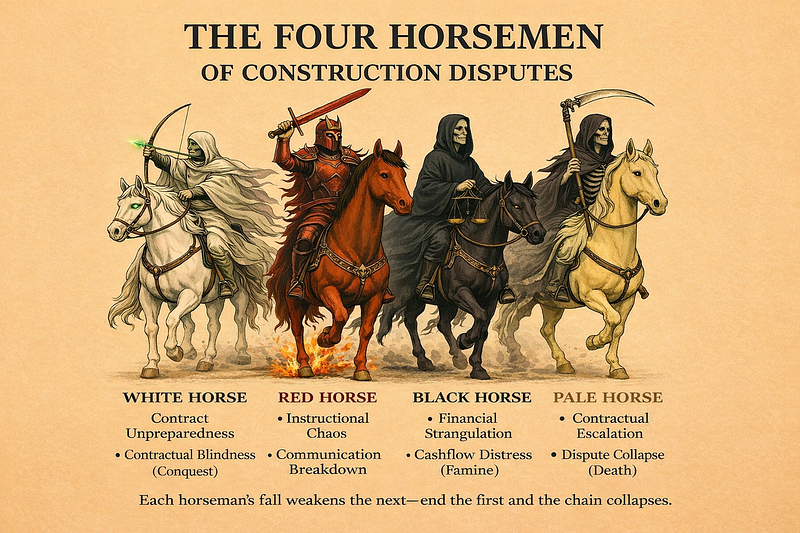
The First Horse: The White Horse of Contractual Unpreparedness and Contractual Blindness
The most dangerous horse is not the last one.
It is the White Horse — because it looks harmless.
Data Centre Development : Possible Most Likely Scenario
When the First Horse Was Seen — but Not Defeated**
……………………………………………………….
The First Horse: The White Horse of Contractual Unpreparedness and Contractual Blindness
The most dangerous horse is not the last one.
It is the White Horse — because it looks harmless.
It arrives disguised as familiarity:
- A recognised contract form
- A reputable counterparty
- “Standard” amendments
- A known method of measurement
Everyone feels comfortable.
And that is precisely the problem.
The White Horse represents contractual illusion — the belief that a contract is understood simply because it looks familiar.
In data-centre projects, that belief is fatal.
Why Data Centres Punish Contractual Blindness
Data centres are not difficult because of concrete or steel.
They are difficult because:
- Design is intentionally incomplete at contract award
- Interfaces multiply across trades and specialist vendors
- Works are resequenced repeatedly
- Time and cost are inseparable
In this environment, contract administration is not a back-office function.
It becomes a frontline risk-control system and necessity .
If that system is built on unexamined amendments, inherited assumptions, and legacy QS measurement rules, disputes are not an outcome — they are a inecitable.
The Silent Accelerator: Amended SMMs in Malaysia
Malaysia continues to rely heavily on SMM2, almost always with amendments.
These amendments are typically introduced:
- Through special conditions
- Via EPC-driven risk reallocation
- Or by employer-specific carve-outs
Crucially, they are rarely examined in conjunction with the rest of the Contract Documentsintandem leaving the contract andproject execution teams working in silos.
They are read clause-by-clause — which is exactly how risk slips through unnoticed.
New Chapter: Why Amended SMMs Become a Trap in Data-Centre Projects
SMM2 was never designed for:
- Progressive design development
- Abortive works arising from coordination
- Builder’s work linked to specialist systems
- Productivity loss caused by access and sequencing constraints
Yet these are core characteristics of modern data-centre projects.
The result is a dangerous mismatch:
Uncertainty on site — certainty denied in valuation.
Amended SMMs in Malaysia commonly:
- Restrict re-measurement
- Exclude abortive or re-work
- Expand “included works” definitions
- Decouple delay entitlement from cost recovery
On paper, nothing looks dramatic.
On site, everything changes.
What Most Likely Happened (Hypothetical — but Industry-Familiar)
Stage 1 — Pricing Comfort
- Contractor priced based on familiar SMM logic
- Amendments were accepted as “commercial terms”
- Design gaps were assumed to be variation-friendly
The White Horse passed unchallenged.
Stage 2 — Execution Reality
- IFC drawings issued in waves
- Interfaces multiplied
- Works were resequenced, revisited, and partially undone
The site kept building.
The contract quietly started bleeding.
Stage 3 — Measurement Turns Hostile
- Variations disputed as “included works”
- Re-work treated as contractor risk
- Productivity loss dismissed as inefficiency
Measurement rules became weapons, not mechanisms.
Stage 4 — Time and Money Artificially Separated
- Extension of Time assessments delayed or constrained
- Cost recovery deferred or denied
- Cashflow tightened
This is where the Black Horse begins to stir.
Stage 5 — Escalation Becomes Inevitable
- Claims harden
- Positions entrench
- Arbitration becomes unavoidable
By then, the dispute is already fully formed.
Why This Could Have Been Drastically Minimized
This was not a failure of construction capability.
It was a failure of Contract Preparedness.
The dispute did not start with delay.
It started with poorly developed induction — or the lack of it.
The Only Real Solution: CETRIS Phase 1 — Contract Preparedness Induction
CETRIS Phase 1 is not training.
It is not theory.
It is induction with intent.
Its purpose is simple:
To ensure the contract and project execution teams are contract-ready from Day One — with no Contractual Blindness OR payment blind spots.
What CETRIS Phase 1 Must Contain (No Stone Unturned)
1. Helicopter View of the Entire Contract
A full end-to-end walkthrough covering:
- Commercial intent
- Risk allocation logic
- Payment and certification mechanics
- Time–cost linkage
No clause isolation.
Only how the contract behaves under pressure.
2. Form-Specific Risk Mapping
Clear identification of:
- The base form used
- Every amendment made
- Silent risk transfers introduced
Teams must clearly understand:
- What is no longer claimable
- What now requires proof
- What risks were never priced
3. Dedicated SMM Amendment Deconstruction (Malaysia-Specific)
The induction must:
- Compare standard SMM2 vs amended SMM
- Identify:
- Measurement exclusions
- Re-measurement prohibitions
- Design-development blind spots
- Expose false assumptions commonly made by site teams
This single module alone can prevent seven-figure disputes.
4. Time–Cost Reality Alignment
The programme must:
- Eliminate the myth of “EOT first, cost later”
- Train teams to record time and cost concurrently
- Treat delay as financial exposure, not a calendar issue
Delay without cost is an illusion.
5. Claims Are Not Disputes — Until Mishandled
Teams must understand:
- Proper notice discipline
- Contemporaneous record strategy
- Certification behaviour and psychology
Most disputes are administrative failures, not legal ones.
6. Role-Specific Induction
Comprehensive 4 hours briefings for:
· Site supervisors
· Planning engineers
· Document Control team
· QS teams
· Contract execution teams
· Project execution team
Final Takeaway: Kill the White Horse Early
This dispute did not need to reach arbitration.
Had CETRIS Phase 1 been implemented:
- Contractual blind spots would have been exposed
- Amended SMM payment risks would have been neutralised
- Time and cost would have been aligned from Day One
- Any dispute would have remained commercially manageable — not project-threatening
Data centres do not fail because teams are incompetent. They fail because contracts are misunderstood — collectively.
Defeat the White Horse at induction,
and the Red, Black and Pale Horses rarely leave the stable.
This Article is applicable and relevant for both sides of the divide - The Employer and his Consultants and the many Contractors working on a Data Centre Project.