IT WAS NEVER YOUR LAW
The Construction Law Reset: Unlearning 15 Years of Imported and Unquestioned Common Law Principles
The Dynamics of Construction Law under the Civil, Sharia+ and Common Law Jurisdictions
Foreword
More than fifteen years have passed since Roger Knowles set the construction world talking. His One Hundred Contractual Problems and Their Solutions, and the seminar series built around it, did something few legal texts manage. It took the law out of the library and onto the site office desk. Engineers, quantity surveyors and project managers suddenly had a vocabulary for claims and disputes. A generation of practitioners owes its first serious look at construction law to that work.
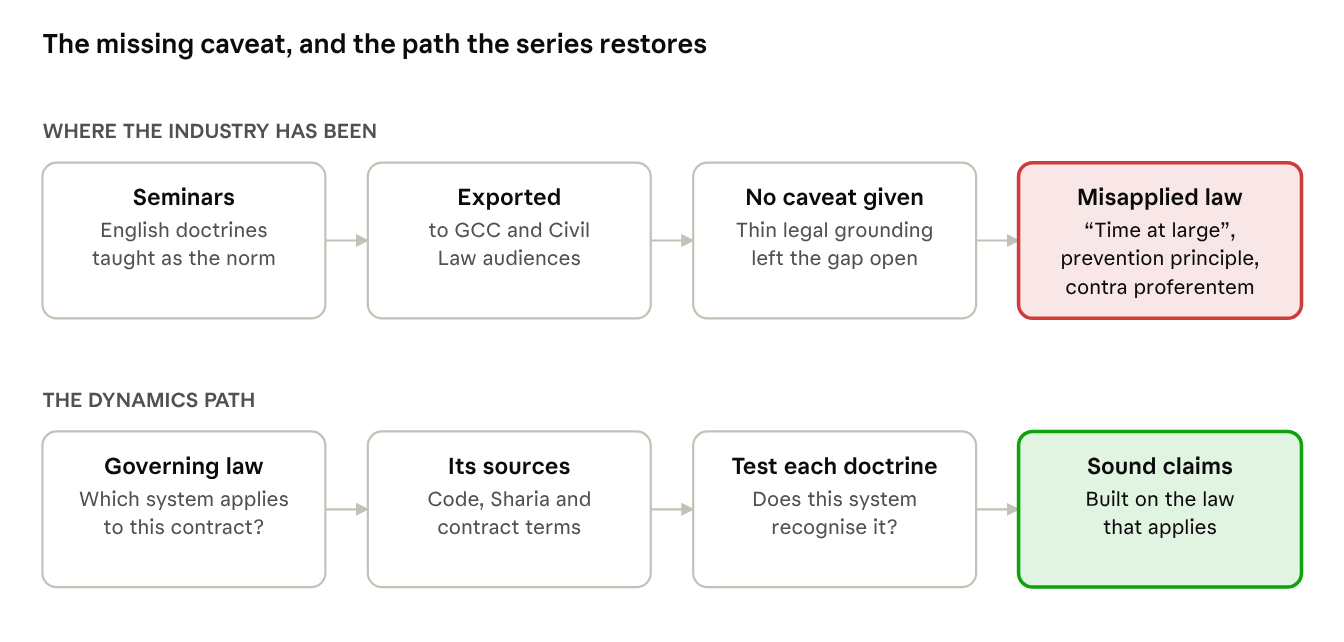
Yet success on that scale carries a hidden cost. The seminars travelled well beyond England. They filled rooms across the GCC, in Sharia+ jurisdictions such as the UAE and Qatar, and in Civil Law countries further afield. What did not travel with them was a caveat. Nobody told those audiences, clearly and repeatedly, that the doctrines being taught were doctrines of English Common Law.
That silence mattered. In Civil Law and Sharia+ jurisdictions, Common Law doctrines and judicial precedents are not sources of law. The law there is found first in the civil code. Where the code is silent, a Civil Law judge reasons from its general principles, while a Sharia+ judge turns to Islamic Sharia. Save for common-law enclaves such as the DIFC and ADGM courts, an English judgment carries no binding weight in a Gulf courtroom or an arbitration seated under local law. Over time, an impression took hold that English construction law is universal. It is not, and it never was.
By Sharia+ I mean jurisdictions whose civil codes direct the judge to Islamic Sharia, ahead of custom, wherever the legislative text is silent. The UAE and Qatar say so in Article 1 of their civil codes; in Saudi Arabia, Sharia is the foundation of the legal order itself. The test is simple: when the code runs out, what does the judge reach for next?
Figure 1 — Sources of law, three traditions compared. Only in the Common Law column does an English judgment carry binding force; in the Civil Law and Sharia+ columns the code and Sharia come first (see the comparison table below).
The knowledge gap
The misunderstanding found fertile ground. Engineers, designers, project managers and quantity surveyors are the people who run claims and disputes day to day. Yet their formal grounding in law is thin. Quantity surveyors fare a little better, with some contract and law in their syllabus. Even so, it is nothing like the three or more years of legal study their lawyer colleagues complete.
For most construction professionals, legal understanding is assembled piece by piece. It comes from talks, seminars, webinars and self-study. Each piece may be accurate on its own. Without a framework to hold them together, though, the pieces rarely add up to a correct picture of how construction law actually applies in a given jurisdiction.
The doctrines that did not travel
The result is familiar to anyone who has sat through a Gulf arbitration. Claims arrive built on the assumption that “time at large”, the prevention principle or the English reading of contra proferentem apply everywhere. They do not. Civil Law and Sharia+ systems ask different questions. They look to the code: to good faith in the performance of contracts, to causation, to the apportionment of fault where both parties contributed to the delay, and to the court’s power to adjust an agreed damages figure towards the actual loss.
Doctrine check — the same question, three legal answers:
| Issue | English Common Law | Civil Law (e.g. France, Germany) | Sharia+ (e.g. UAE, Qatar) |
|---|---|---|---|
| Where the rule comes from | Statute and binding precedent | The civil code; court decisions guide but do not bind | The civil code, with Sharia as a source of legislation |
| When the written law is silent | Courts develop the rule through case law | The code’s general principles and legal doctrine | Sharia first, then custom, then justice (Article 1 of both civil codes) |
| Time at large | The prevention principle’s remedy: employer prevention with no extension-of-time route sets time at large; liquidated damages fall away | No such doctrine; delay is judged on causation and good faith under the code | No such doctrine; the code’s rules on causation and good faith apply, with Sharia filling any gap |
| Prevention principle | A principle of contract construction (Holme v Guppy to Multiplex): a party cannot benefit from its own breach; clear terms can displace it (North Midland) | Reached through good faith and causation, not a separate doctrine | Reached through the code’s good faith and causation rules |
| Contra proferentem | Ambiguity read against the party who drafted or relies on the term; now used sparingly in commercial contracts, mainly for exclusion clauses (Persimmon v Arup) | A code rule, not case law: doubt resolved for the debtor; standard terms read against the party who proposed them (French Civil Code Art. 1190; BGB §305c) | A code rule, not case law: doubt resolved in favour of the debtor; in adhesion contracts, ambiguity is never read against the adhering party |
| Liquidated damages | Enforceable unless a penalty, judged by legitimate interest | Courts may reduce an excessive penalty clause (France also allows raising a derisory one) | Courts may adjust agreed damages up or down towards the actual loss |
| Good faith | No general duty in English contract law | A mandatory duty (French Civil Code Art. 1104; German BGB §242) | A mandatory duty in performing every contract |
| English case law | Binding precedent | Not a source of law | Not a source of law; persuasive at most |
The second row is the Sharia+ test in action: the same silence in the code sends a French judge to general principles and an Emirati or Qatari judge to Sharia. The exact rules differ from code to code — the UAE, Qatar and Saudi Arabia each have their own civil transactions law — but the method is the same.
The Dynamics series — the missing chapter
The Dynamics of Construction Law under the Civil, Sharia+ and Common Law Jurisdictions exists to revisit this body of misinformation and incomplete knowledge. It sets the three legal traditions side by side. It explains where each finds its law, what each does when the written law is silent, and how each treats time, delay, variation, damages and termination. Where they genuinely converge, it says so; where they diverge, it shows why.
The aim is to fill the gaps, clear the cobwebs and provide the clarity that should have accompanied those seminars fifteen years ago. This is not a criticism of what came before. It is the missing chapter: the caveat that was never given, now given in full.
Resetting how the construction industry claims
The reset cannot be done one person at a time. A claim is shaped long before it reaches a lawyer: in the site instruction, the delay notice, the variation record and the daily correspondence. If only one or two people in a company understand which law governs the contract, the rest will keep building claims on the wrong foundation.
An invitation to reset
CIDEC, the Construction Industry Disputes Education Centre, now opens registration for The Dynamics of Construction Law Webinar on a company-wide, en bloc basis.
We therefore invite the Chief Operating Officers and Human Resources departments of construction companies to enrol their execution and delivery teams on large-scale projects as one cohort: project directors, project and construction managers, planners, quantity surveyors, contract administrators and design managers. Trained together, they share one vocabulary, one method and one mindset.
One session. One reset. The programme is a single three-hour session, priced at USD 1,500 per group of 8 to 13 participants.
Register your company today via our course registration page or contact us. A CIDEC programme advisor will contact you within 3 to 4 working days to understand your teams, your projects and the laws that govern your contracts, and to schedule a session built around them.
Steven Chin
Master Trainer & Chief Strategist, CIDEC Consultancy
Construction Industry Disputes Education Centre — November 2026
Know the law that governs. Claim it the right way.